
The M20 is a key route through south-east England, connecting the London motorway network with Maidstone, Ashford and Folkestone. It also provides access to the Channel Tunnel, while the A20 continues towards the Port of Dover. This gives the motorway an important role in both everyday travel through Kent and longer international journeys.
For drivers, that means sharing the road with a varied mix of traffic. Local journeys and commuter trips overlap with holiday travel, coaches, delivery vehicles and heavy goods vehicles heading towards the Channel crossings. Kent’s traffic-management authorities advise motorists to prepare for delays and check their route before travelling, even when they are not leaving the country.
Understanding the main junctions and the arrangements that may be introduced during disruption can make the journey easier to plan. The sections below highlight places where merging traffic, route decisions and temporary restrictions deserve particular attention. This is a practical driving guide, not a statistical ranking of the motorway’s most dangerous locations.
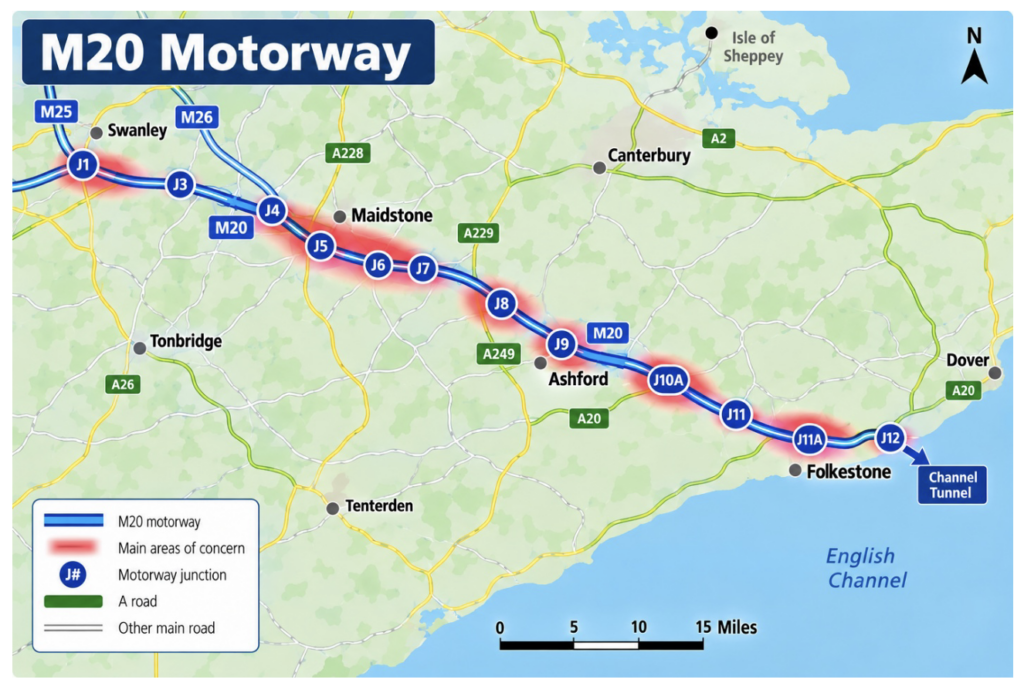
Main Areas of Concern
M25/M26 to Maidstone: Major Interchanges and Changing Traffic Flows
At its western end, the M20 connects with the M25 at Swanley. Further east, the M26 joins at M20 Junction 3, providing another connection with the M25. These interchanges bring together traffic approaching Kent from different parts of the motorway network.
Approach major interchanges with a clear idea of your route. Read the direction signs early rather than waiting until the last opportunity to choose a lane. When joining the motorway, give priority to traffic already on it and adjust your speed to enter safely. Do not assume that another driver will move over to make space.
This section also requires awareness of the motorway’s emergency arrangements. The M20 between Junctions 3 and 5 is an all-lane-running section, where the former hard shoulder is used as a traffic lane. National Highways added four emergency areas here through its South East retrofit programme, with the regional work completed back in spring 2025. National Highways
Emergency areas provide somewhere to stop in an emergency when leaving the motorway or reaching a service area is not possible. They are identified by blue signs featuring an orange SOS telephone symbol. Familiarising yourself with these signs is worthwhile before you need them.
Maidstone: Junctions 5 to 8
The Maidstone section contains several junctions serving the town and connecting the motorway with other major routes. Junction 6 links with the A229 towards Medway and the M2, while Junction 7 connects with the A249 towards the M2 and Swale, as well as routes into Maidstone. The motorway here therefore serves more than simply coastbound through traffic. Kent County Council
Treat this as a section where early observation matters. Check mirrors regularly, anticipate vehicles moving towards exits and leave yourself time to respond without abrupt braking or steering. When your own exit approaches, move into the appropriate lane in good time. Missing a junction is preferable to cutting across traffic; continue to the next exit rather than attempting a last-second manoeuvre.
In queues, resist the temptation to keep changing lanes because another line briefly appears to be moving faster. Stay attentive to the vehicles around you and keep a safe gap, rather than focusing only on gaining a few car lengths.

Maidstone to Ashford: Junctions 8 to 9 and Operation Brock
The stretch between Junctions 8 and 9 is particularly important because of Operation Brock, the traffic-management system used to help manage disruption to cross-Channel travel. Its purpose is to control freight movements while keeping other traffic moving through Kent where possible.
When the contraflow is operating, traffic is separated into different lanes across the carriageways. Europe-bound freight follows designated arrangements, while other traffic uses the signed routes through the system. Drivers should not assume that the normal layout will apply simply because they have travelled this section before.
Installing or removing the contraflow can require overnight closures. National Highways identifies potential closures between Junctions 7 and 9 eastbound and Junctions 8 and 9 westbound for these operations. Additional restrictions can be introduced during more serious disruption, so the effect is not necessarily confined to the central Brock section. National Highways
Check the current arrangements before setting off, then follow the roadside signs and instructions given by officers. Temporary diversions may differ from your usual route. Freight drivers should also distinguish between signs for cross-Channel freight and those for local or other traffic; the correct route depends on the journey being made.
Leave generous space through any contraflow. Temporary barriers, altered lane positions and reduced speed limits require steady driving, particularly when travelling beside larger vehicles. Do not treat an apparently clear lane ahead as a reason to disregard the restrictions.
Ashford: Junctions 9 to 10A
Around Ashford, the motorway serves a sequence of local connections as well as continuing towards Folkestone. Junction 10A was introduced to relieve pressure around the existing Junction 10 and includes a link to the A2070. Its construction also involved permanently closing the coast-facing slip roads at Junction 10.
That makes it especially important to check the correct junction and direction for your destination, rather than assuming that every exit provides the same movements. For a local visit, identify the final approach before leaving home, not while passing the first Ashford signs.
Give yourself room to react as you approach slower traffic. Look beyond the vehicle immediately in front and be ready for a queue to develop ahead. Your speed and following distance should always allow you to stop safely within the distance you can see to be clear.
Folkestone and the Channel Tunnel: Junctions 11A to 13
For passenger vehicles using LeShuttle, Junction 11A is the exit for the Folkestone terminal. LeShuttle advises drivers to follow the passenger signs and warns that relying on a postcode alone can send some navigation systems towards the wrong entrance, freight routes or service roads. There is no need to drive through Folkestone town to reach passenger check-in. LeShuttle
Before reaching this section, be clear whether you are heading for the Channel Tunnel, Folkestone itself or Dover. Traffic continuing towards Dover follows the M20 to its eastern end at Junction 13 and then the A20. The Channel Tunnel exit and the onward route to Dover are not interchangeable.
Follow your crossing operator’s latest arrival and check-in guidance, rather than relying on the motorway journey time alone. Build in time to reach the terminal and allow for any disruption reported before departure.
For drivers who have already travelled a long distance, this is also a time to stay alert for fatigue. Being close to a booked crossing is not a reason to continue when tired. Plan rest stops into the wider journey, rather than treating the terminal as the first opportunity to take a break.
Driving Safely on the M20
Maintain a Proper Following Distance. In dry conditions, allow at least a two-second gap from the vehicle ahead on high-speed roads. The Highway Code says to double this gap on wet roads and increase it substantially on ice. Two seconds is a minimum guide for suitable conditions, not a guarantee that every situation is safe.
A useful check is to choose a fixed roadside point and count the time between the vehicle ahead passing it and your own vehicle reaching it. Increase your following distance when visibility deteriorates or when you need a better view past a larger vehicle. Avoid closing the gap simply because another driver moves into it.
Give HGVs Space and Avoid Lingering Beside Them
Large vehicles have areas of limited visibility in front, behind and along both sides. We advise motorists not to linger in these zones and to leave enough space to complete an overtake safely.
Before passing a lorry, check that there is room ahead to finish the manoeuvre. Do not pull back into its lane too quickly or cut into its braking space. When following, dropping back improves your view of the road and makes it easier for the driver to see you.
This is particularly relevant when approaching junctions or driving through temporary traffic arrangements. Focus on staying visible and predictable, rather than trying to take every available gap.
Follow Signals and Keep Lane Changes Predictable
A red X means that the lane is closed and must not be used. A speed limit displayed within a red circle is mandatory, even when you cannot see the incident or congestion that prompted it.
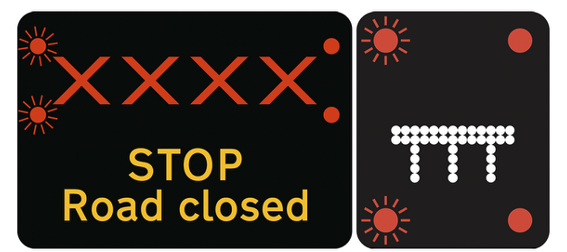
Keep left when not overtaking, subject to the signs and lane arrangements in operation. When changing lanes, check carefully, signal clearly and move only when there is sufficient space. Good lane discipline matters throughout the route, not just around its major interchanges.
Adjust for Rain, Spray and Poor Visibility
Rain can reduce tyre grip, while spray from other vehicles can make it harder to see and be seen. Slow down appropriately, increase the distance ahead and use your lights as required by the conditions.
In fog, drive at a speed that allows you to stop within the distance you can see clearly. Do not follow another vehicle’s rear lights too closely or assume that its driver has judged the conditions correctly. Fog lights should only be used when visibility is seriously reduced and must be switched off when visibility improves.
Preparing for an M20 Journey
Check Both Incidents and Planned Closures
Before travelling, check National Highways live traffic information and its planned closure report. These serve different purposes: a road that looks clear when you check may still have scheduled overnight works later in your journey.
Pay particular attention when leaving late at night or early in the morning. National Highways state that early journeys can be affected by closures that began the previous evening. Check the direction of travel and the affected junctions, rather than relying on a headline stating only that the M20 has roadworks.
Prepare the Vehicle and Carry Essentials
Check tyres, lights and fluid levels before setting off, and make sure you have sufficient fuel or battery charge for the journey with a sensible margin. Carry drinking water, food, regular medication and anything needed by children or pets travelling with you. These preparations are particularly valuable when a cross-Channel delay affects the surrounding road network.
Allow time for stops as well as traffic. The Highway Code recommends a break of at least 15 minutes after every two hours of driving, and advises against beginning a journey when tired. Build this into the full trip, including any driving before reaching the M20.
What to Do if You Break Down
If your vehicle develops a problem, leave the motorway or reach a service area if possible. Otherwise, move left and use an emergency area or hard shoulder where available. Switch on your hazard warning lights.
Where it is safe and possible, leave through the side furthest from traffic and move well away from the vehicle and carriageway, behind a safety barrier where available. Use the emergency telephone for assistance. Do not attempt roadside repairs or place a warning triangle on the motorway.
If you are stranded in a live lane and cannot get out safely, remain in the vehicle with seat belts fastened and hazard lights on, and call 999 immediately, asking for the police. The same emergency assistance is important when a disability prevents you from following the usual evacuation advice.
Before leaving an emergency area to rejoin the motorway, use the emergency telephone and follow the operator’s instructions. A lane may need to be closed to help you rejoin safely.
Why the M20 Deserves Careful Planning
The M20 combines local access, major motorway connections and international travel within one route. Around Maidstone and Ashford, pay attention to junctions and lane choice; nearer Folkestone, know the correct terminal approach. During Channel disruption, temporary arrangements can change how parts of the motorway operate.
The practical approach is straightforward: check before travelling, leave enough time, maintain a safe gap and make decisions early. Treat the journey as a series of changing conditions rather than assuming the entire motorway will behave like the section you have just driven.