
UK ROAD SAFETY GUIDE | SOUTH GLOUCESTERSHIRE AND BRISTOL
The M49 may be one of Britain’s shortest motorways, but its importance to the South West’s road network should not be underestimated. Stretching approximately 5 miles between the M4 at Junction 22 near Pilning and the M5 at Junction 18A near Avonmouth, it provides a direct connection between South Wales, Bristol and the South West of England.
Opened in 1996 alongside the Second Severn Crossing, now known as the Prince of Wales Bridge, the M49 was designed to allow motorists to travel between the M4 and M5 without using the busy Almondsbury Interchange.
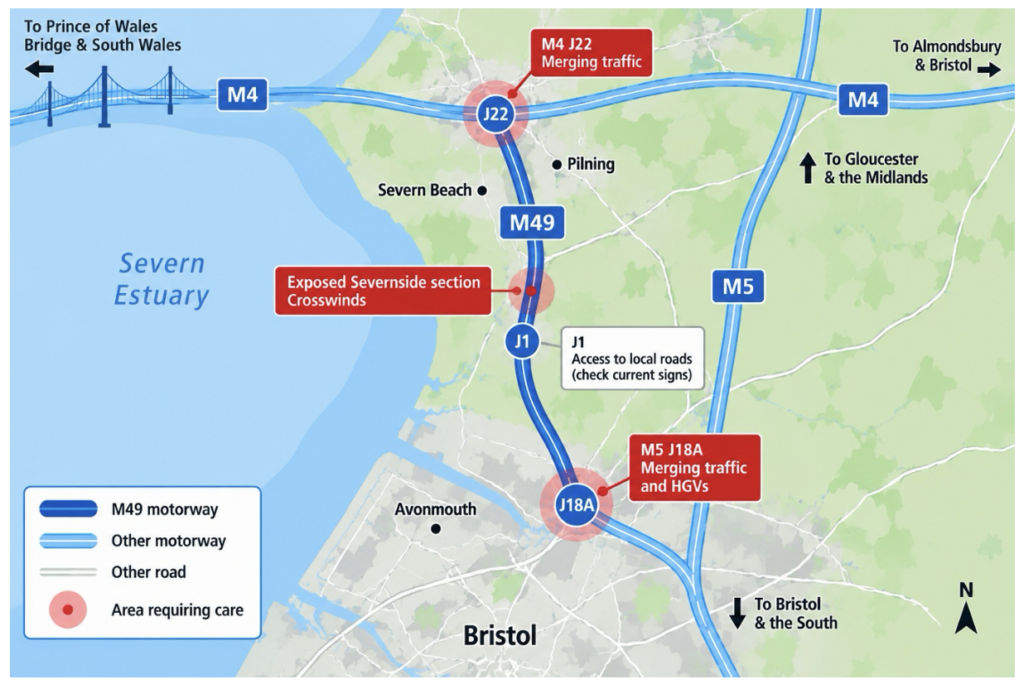
Although the motorway is relatively short and straightforward, it carries a mixture of cars, commercial vehicles and heavy goods traffic travelling between major motorway networks. Its proximity to the Severn Estuary, industrial areas and busy interchanges creates several potential hazards that motorists should be aware of.
Main areas of concern along the M49
1. M4 Junction 22 – Pilning and the Prince of Wales Bridge
The northern end of the M49 joins the M4 near Pilning, just east of the Prince of Wales Bridge. This is an important interchange for drivers travelling between South Wales and the South West. Motorists approaching from the M4 must select the correct route towards the M49 or continue along the M4. Drivers unfamiliar with the junction may make late lane changes or brake unexpectedly.
Traffic conditions can also change when incidents, roadworks or restrictions affect the Severn crossing.
Safety advice: Follow motorway direction signs well in advance, avoid last-minute lane changes and be prepared for traffic slowing near the interchange.
2. Northern M49 – Severn Beach and Pilning
The northern section of the M49 passes close to Severn Beach and the low-lying countryside surrounding the Severn Estuary. Although the motorway generally has a straightforward alignment, exposed conditions can make driving more difficult during periods of strong wind or heavy rain. Crosswinds may particularly affect vans, caravans and high-sided vehicles, while heavy spray can reduce visibility.
Safety advice: Adjust your speed to the conditions, maintain a firm grip on the steering wheel during strong winds and increase your following distance in wet weather.
3. M49 Junction 1 – Severnside and Avonmouth industrial area
A new intermediate junction was constructed to provide access to the Avonmouth and Severnside industrial areas. However, the junction’s connecting road was not completed alongside the motorway works, and its opening has been subject to a separate project. Drivers should not assume that Junction 1 provides access to local roads without checking its current operational status.
Once fully connected, the junction could introduce additional merging and diverging traffic, including HGVs serving nearby industrial estates.
Safety advice: Follow the current motorway signs and never attempt to use a closed slip road or restricted access point.
4. Southern M49 – Approaching Avonmouth
As the M49 heads south towards the M5, drivers approach one of the region’s important freight and distribution areas. The nearby Avonmouth docks and industrial estates generate commercial traffic, including large lorries travelling to and from the motorway network. Although the motorway itself may be relatively quiet, vehicles can be travelling at different speeds, particularly when approaching the M5 interchange.
Safety advice: Allow plenty of room when overtaking HGVs, avoid lingering in blind spots and maintain a safe distance from slower-moving vehicles.
5. M5 Junction 18A – Avonmouth Interchange
The southern end of the M49 connects with the M5 near Avonmouth, providing onward routes towards Bristol, the South West and the Midlands. This is a particularly important area because traffic from the M49 joins a much busier motorway network.
Drivers may encounter merging vehicles, changing lane arrangements and congestion associated with the wider Bristol motorway system. The interchange also includes connections towards Avonmouth and the A4 road network, making advance lane selection especially important.
Safety advice: Read direction signs early, check mirrors and blind spots before merging and avoid forcing your way into small gaps in traffic.
Other hazards motorists should consider
Strong winds and poor weather: The M49’s position close to the Severn Estuary means exposed conditions can affect vehicle handling. Reduce speed in strong winds and remain alert to sudden gusts. Heavy goods vehicles: The motorway serves an important commercial corridor. Give lorries extra space and remember that larger vehicles need greater stopping distances.
Driver fatigue and complacency: A short, relatively quiet motorway can encourage motorists to relax their concentration. Stay alert, particularly when approaching the busier M4 and M5 junctions.
Sudden congestion: Even when traffic is flowing freely along the M49, incidents or roadworks on either connecting motorway can cause queues to develop unexpectedly.
Staying safe on the M49
The M49 may be only 5 miles long, but it plays a vital role in connecting two of the South West’s busiest motorway routes.
Its relatively simple layout should not encourage complacency. Drivers should stay particularly alert near the M4 and M5 interchanges, where traffic movements and road conditions can change quickly. Planning your journey, maintaining a safe following distance, observing speed limits, and leaving enough room for HGVs can all help reduce the risk of incidents.
The key message is simple: even a short motorway journey deserves your full attention. The M49’s motorway interchanges, commercial traffic, and exposed conditions make careful driving essential.