
Date Content Updated – August 2026
Westminster Bridge is one of London’s most recognisable landmarks, but it is also a busy working transport route. Every day it carries commuters, visitors, hospital patients, buses, taxis, private vehicles and a substantial flow of cyclists between Westminster and the South Bank.
The present bridge dates from 1862 and was designed by Thomas Page. Its seven cast-iron arches, grey-granite piers, Gothic detailing and ornamental lamp standards complement the neighbouring Palace of Westminster. It is protected as a Grade II* listed structure. Modern safety works have added permanent protected space for people walking and cycling on both sides of the bridge.
The key to crossing safely is simple: use the correct part of the bridge, follow the signals at each end and remember that other people may be commuting even while you are sightseeing.
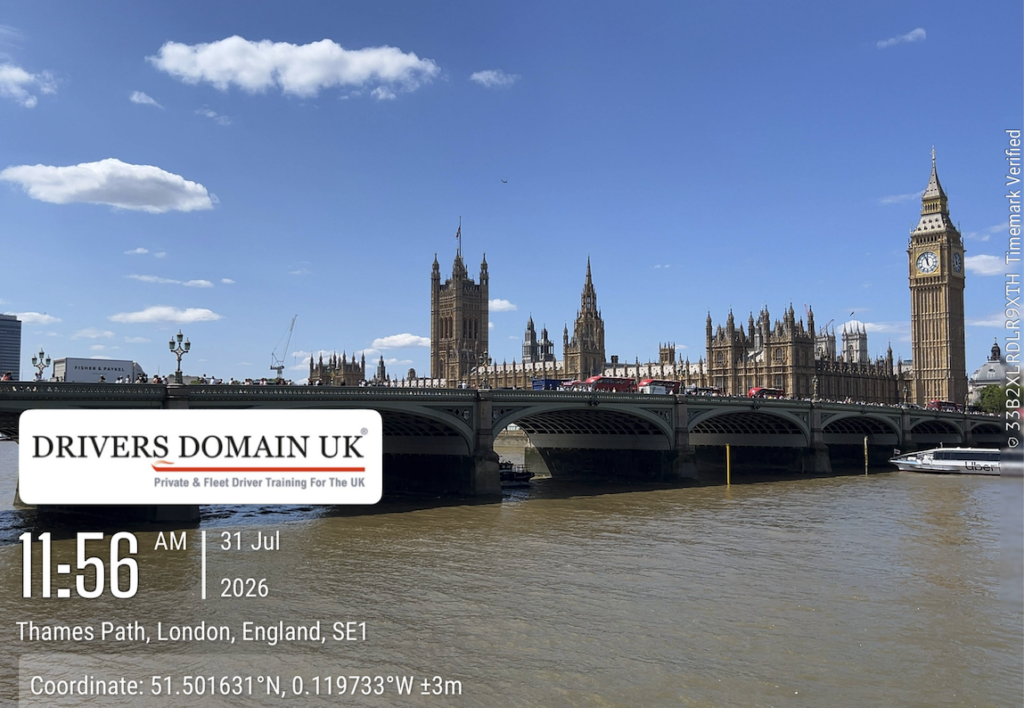
Westminster Bridge at a glance
The bridge connects:
The Westminster end, beside Elizabeth Tower, the Palace of Westminster, Westminster Underground station and Parliament Square.
The Lambeth and South Bank end, beside St Thomas’ Hospital, County Hall and the routes towards the London Eye, Waterloo and Lambeth North.
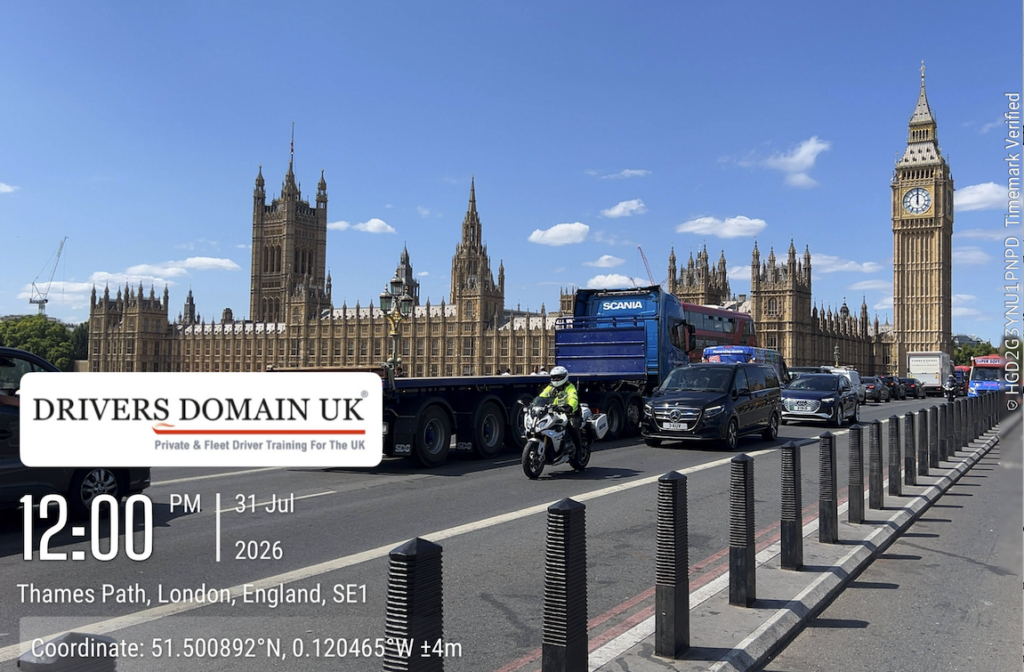
Pedestrians have a footway on each side. Cyclists have a protected, one-way cycle track on each side. Motor traffic uses the central carriageway, where a 20 mph limit applies. TfL’s scheme also introduced cycle signals and upgraded pedestrian crossings around the southern junction.
A person walking continuously can cross the bridge itself in around five minutes, although ten minutes or more is sensible when it is crowded or when stopping for photographs. For cyclists and drivers, the traffic signals and junctions at either end usually determine the journey time more than the bridge does.

Understanding the two ends of the bridge
The Westminster end
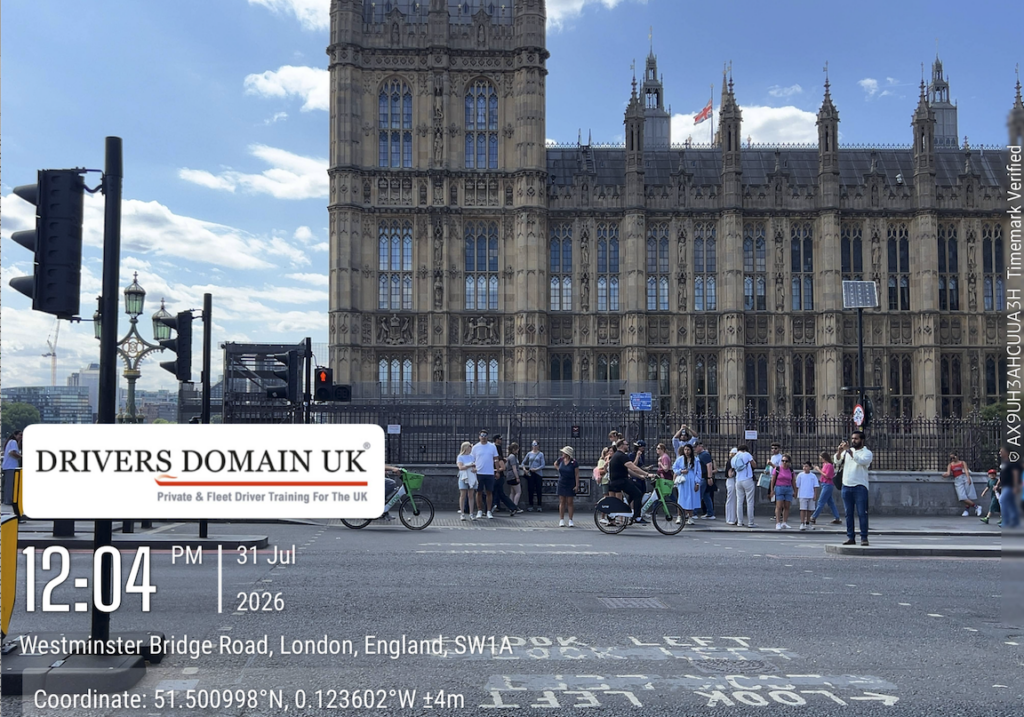
At the north-western end, the bridge becomes Bridge Street. Westminster Underground station is immediately beside the junction, serving the Circle, District and Jubilee lines. Parliament Square, Westminster Abbey, Whitehall and the parliamentary estate are all within a short walk. See photo below.
The tower beside the bridge is properly called Elizabeth Tower. Big Ben is the Great Bell hanging inside it, although the name is commonly used for the entire tower and clock.
This end of the bridge has several closely spaced crossings, traffic signals, cycle signals and turning movements. Pedestrians should wait for their own green signal rather than following a crowd. Cyclists and drivers should expect people to appear distracted by the landmarks.
The South Bank and Lambeth end
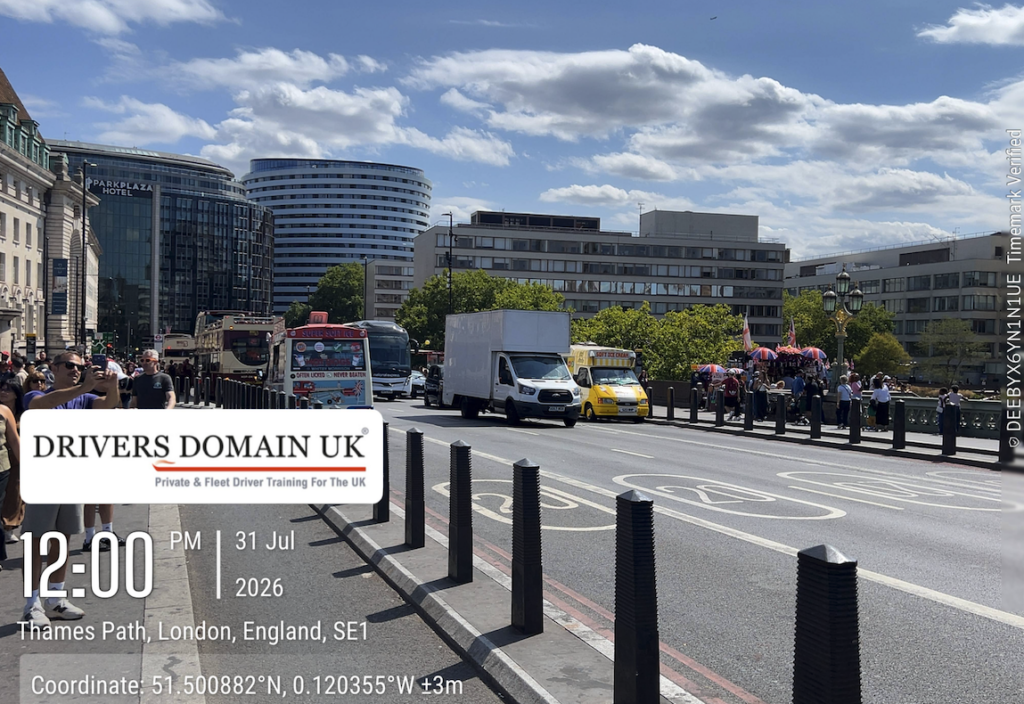
At the south-eastern end, the bridge leads into Westminster Bridge Road. St Thomas’ Hospital is immediately to the right when travelling from Westminster; see photo below, while County Hall, the London Eye and the main South Bank visitor area are on the opposite side.
The junction here includes protected cycling facilities, signal-controlled crossings and bus-stop bypass arrangements. TfL added wide zebra crossings over sections of cycle track near St Thomas’ Hospital to help pedestrians move between the pavement and bus stops.
This end can be particularly complicated for first-time visitors because several routes converge close together. Do not assume that everyone moving beside the pavement is a pedestrian: a clearly marked strip may be an active cycle track.
Advice for pedestrians
Remain on the pedestrian footway
Both sides of Westminster Bridge have pedestrian space separated from general motor traffic. Keep within the footway and avoid walking, standing or placing luggage in the adjoining cycle track.
The cycle track may appear quiet when you first look, but a cyclist can reach you within seconds. Before crossing any section of cycle track at the ends of the bridge, look in both directions, even where the track is officially one-way.
Groups should avoid spreading across the entire footway. Leave room for people walking more quickly, wheelchair and mobility-scooter users, buggies and anyone trying to reach St Thomas’ Hospital or public transport.
Where to find the best views
The footway nearest the Palace of Westminster provides the classic view of the Palace’s river frontage and Elizabeth Tower. The opposite footway looks towards the London Eye, County Hall and the central South Bank.
Pedestrians may use either side, so choose the side that suits your destination and the view you want. Cyclists, however, must follow the direction of the marked one-way cycle track rather than selecting a side for photography.
For a photograph, move close to the bridge railing without blocking the main walking line. Check behind you before stepping sideways or backwards. Never step into the cycle track while looking through a camera or phone.
Early morning generally offers a calmer crossing and more space for photographs. Later evening can also be quieter, with the illuminated Palace and South Bank providing a different view. Westminster Bridge is one of the capital’s most popular sightseeing crossings, so congestion should be expected during the middle of the day and at weekends.

Crossing with children
Keep young children on the side of the footway away from the cycle track. At the approaches, hold hands until the whole group has crossed every section of road and cycle track.
Do not allow children to sit on, climb or lean through the bridge balustrade. When using a buggy, avoid stopping at the narrowest points beside barriers or crossing controls.
Wheelchairs, mobility scooters and buggies
Westminster Bridge itself is wheelchair accessible, and the route over it is step-free. UK Parliament nevertheless warns that it can become very busy. An accessibility survey of the route between Westminster station and St Thomas’ Hospital describes a tarmac surface, an easy upward gradient followed by a more noticeable downward gradient, and some restricted spaces around obstacles near the ends.
The direct route from Westminster Bridge down to the riverside Queen’s Walk is stepped. Anyone requiring a step-free route towards the London Eye should continue using street-level routes towards Belvedere Road and Jubilee Gardens rather than following the riverside steps.
Allow additional time during busy periods. People using mobility aids may find the bridge easier early in the morning, when sightseeing groups are less likely to be stationary on the footway.
Advice for cyclists
Use the correct protected track
Westminster Bridge has a one-way protected cycle track on each side. Follow the arrows, cycle symbols and dedicated cycle signals. Do not ride against the marked direction, even when the opposite track appears empty.
The tracks are separated from motor traffic, but they remain busy commuter routes. Keep a predictable line, check behind before overtaking another cyclist and leave enough distance to stop if a pedestrian enters the track.
Cyclists must keep to the cycling side where a cycle track runs beside a footway. Cycling on the ordinary pavement is prohibited unless signs specifically designate shared use.
Do not stop in the cycle track for photographs
The bridge offers an exceptional view, but the cycle lane is not a viewing platform. Sudden stopping can cause a collision, especially when another cyclist is following closely.
To stop, leave the cycle track at a proper access point, dismount and move completely onto the pedestrian area without blocking it. Do not lift or push a bicycle sideways through barriers.
Slow down at the approaches
The central section of the bridge is relatively straightforward. The greater risks are at the two ends, where pedestrians cross, buses stop, and motor vehicles turn.
At the South Bank end, reduce your speed before the crossings and bus-stop bypasses near St Thomas’ Hospital. Be prepared to stop for people crossing the track, including anyone who may not have seen or heard you. A polite bell or spoken warning can help, but it does not remove your responsibility to slow down.
At cycle-only signal crossings, cyclists must wait for the green cycle symbol. At ordinary zebra, pelican or puffin crossings, cyclists should dismount where required rather than riding through the pedestrian crossing.
When in doubt, dismount
The Highway Code specifically recognises that a cyclist may prefer to dismount and wheel a bicycle through a junction when riding does not feel safe. This is a sensible choice for inexperienced riders, families or anyone confused by the signals at either end.
Once dismounted, behave as a pedestrian: move onto the footway, keep the bicycle under control and do not block crossing points.
Lights and visibility
After dark, a bicycle must have a lit white front light and red rear light, together with the required rear and pedal reflectors. The bridge is illuminated, but lighting is still necessary so that other riders, drivers and pedestrians can recognise your movement.
In rain or strong crosswinds, reduce speed and keep both hands available for control. Wet surfaces, drainage channels and metal covers may be slippery.
Advice for drivers
Treat the bridge as a transport route, not a sightseeing stop
The view may be striking, but drivers should maintain attention on the road. Do not slow abruptly to look at Parliament, take photographs or point out landmarks.
Expect a 20 mph limit and follow the posted signs. Traffic can queue at either end, and pedestrians or cyclists may have a green signal while motor vehicles are held.
Drivers unfamiliar with the UK should remember to keep left and follow the lane arrows well before reaching the junction. Avoid last-second lane changes.
Watch carefully before turning
Use mirrors and check blind spots before changing lane or turning. At junctions, give way to cyclists continuing straight ahead and do not turn across a cyclist using a track or lane.
The Highway Code advises drivers to remain behind cyclists when approaching a junction if turning would cut across their path. Where a cyclist must temporarily use the carriageway, drivers should leave at least 1.5 metres when overtaking at speeds up to 30 mph and wait when that clearance is unavailable.
Large vehicles need particular care because cyclists and pedestrians can disappear into front and side blind spots. Before moving at a signal, confirm that the area immediately beside and in front of the vehicle is clear.

Keep out of the cycle track
Motor vehicles, including motorcycles, are not permitted to drive along protected cycle lanes or tracks. A driver may cross a cycle lane only where the road layout and markings legally allow it, for example, as part of a permitted turn, and must give way to cyclists already using it. TfL can enforce cycle-lane contraventions using cameras.
Do not use the protected track to pass a queue, reach a turning lane or create space for another vehicle.
Do not stop on the bridge.
Westminster Bridge and its approaches form part of London’s closely controlled central road network. Red lines and other road markings restrict stopping, parking and loading. Double red lines mean that ordinary vehicles must not stop at any time unless a specific exemption applies.
Do not stop for:
Passenger collection or drop-off.
Photographs.
Satnav adjustments.
Waiting for another vehicle.
Loading or unloading luggage.
Use an authorised bay or legal stopping point away from the bridge. Blue Badge holders should also check the signs: a Blue Badge does not automatically permit parking or waiting on every red route.
Congestion Charge and ULEZ
Driving across Westminster Bridge places a vehicle in central London’s road-user charging area. Charging hours are 7am–6pm Monday to Friday and noon–6pm on Saturdays, Sundays and bank holidays. There is no Congestion Charge from Christmas Day through the New Year’s Day bank holiday, inclusive. Discounts and exemptions vary, so drivers should check their vehicle and journey before travelling.
ULEZ is separate from the Congestion Charge. It operates across London 24 hours a day, every day except Christmas Day. A car, motorcycle, van or other covered vehicle that does not meet the emissions standard generally incurs a daily charge. A driver may therefore need to pay both charges.
Charges and discounts can change, making TfL’s official vehicle and postcode checkers more reliable than old road signs, blogs or hotel information.
Public transport and onward journeys
Westminster Underground station is beside the Westminster end of the bridge and serves the Circle, District and Jubilee lines. The station has step-free facilities, but individual lifts can fail temporarily, so anyone dependent on step-free access should check the live station status before travelling.
On the south side, Lambeth North serves the Bakerloo line, while Waterloo offers Underground and National Rail connections. Several bus services operate on or near the bridge, but routes can change during road works, demonstrations and major events. TfL’s current central bus map and Journey Planner should be used instead of relying on a permanent list of route numbers.
People visiting St Thomas’ Hospital can cross from Westminster station on a step-free street-level route. AccessAble estimates the complete route from the station to the hospital’s main entrance at approximately 0.3 miles and around seven minutes under normal conditions.
Crowds, belongings and personal safety
Westminster Bridge attracts high numbers of tourists, making it important to keep control of phones, cameras, wallets and bags. The Metropolitan Police has identified theft from the person around Westminster Bridge and other heavily visited Westminster locations as a local concern. Keep phones secure when not in use, close bags properly and remain aware of cyclists or mopeds when standing near a road.
Do not leave a bag or suitcase unattended, even briefly. Apart from the risk of theft, unattended luggage may be treated as a security concern.
Police cordons and temporary bridge closures occasionally occur because of demonstrations, ceremonial occasions, major events, security operations or road incidents. Follow instructions from police and transport staff rather than trying to pass around a barrier. TfL’s traffic-status service provides current information about reported incidents and planned disruptions.
In an immediate emergency, call 999 or 112. For a non-emergency police matter, call 101 or report it online. When describing the location, state “Westminster Bridge” and identify whether you are nearer the Parliament and Elizabeth Tower end or the St Thomas’ Hospital and South Bank end.
The Westminster Bridge checklist
Pedestrians: Use the footway, keep out of the cycle track, pause beside the railing rather than in the main walking line, supervise children and secure phones and bags.
Cyclists: Use the correct one-way track, obey cycle signals, slow at crossings and bus-stop bypasses, and dismount completely before stopping for a photograph.
Drivers: Expect a 20 mph limit, stay out of the cycle track, check for cyclists before turning, do not stop on red lines, and confirm Congestion Charge and ULEZ requirements before entering central London.
Westminster Bridge is at its best when everyone recognises that it is both a landmark and a shared transport corridor. Choose the correct space, move predictably, give other people room and save sightseeing for a safe stopping place. That approach makes the crossing safer and gives everyone more time to appreciate one of London’s finest river views.