
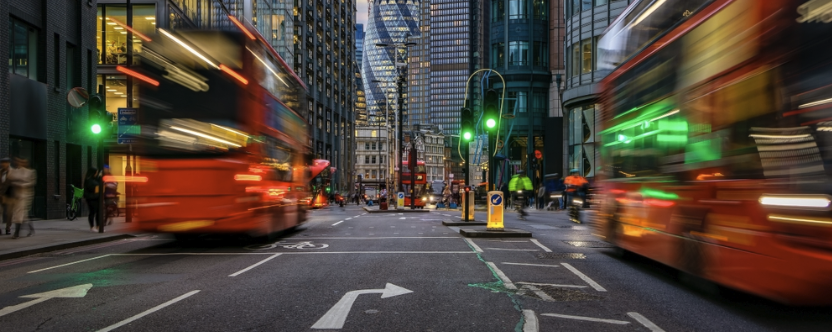
Driving in central London is often less about getting from A to B and more about navigating a relentless mental obstacle course. The city’s roads are a dense web of red routes, bus lanes, cycle superhighways, yellow box junctions and cameras, all layered on top of heavy traffic and unpredictable roadworks.
In central London, driving is not simply a mode of transport; it is a sustained exercise in vigilance. The combination of sensory overload, regulatory complexity and financial penalties creates a uniquely stressful environment that can leave even experienced drivers feeling fatigued long before they reach their destination. Below are five of the most collision-prone areas in the capital.
Collision Area One:
Location – Oxford Street/Tottenham Court Road
What3Words – https://what3words.com/zoom.bunks.bolt
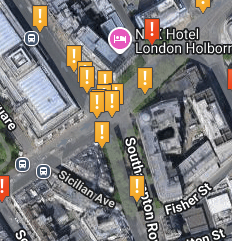
The collision site markers below have been provided by CrashMap.co.uk


Observations:
Locations like this, where multiple traffic streams converge and cross naturally, present a higher collision risk, and this site is a clear example. The area contains several compounding risk factors, including the entrance and exit points of Tottenham Court Road Underground station. Passengers frequently emerge at street level in unfamiliar surroundings, sometimes on the opposite side of the carriageway from their intended destination, leading to sudden, unplanned, or unsafe crossing movements.
The presence of a nearby theatre further increases pedestrian density, particularly during the evening. Large numbers of tourists and visitors, many of whom may be unfamiliar with the local road layout, can be distracted, excited, fatigued, or focused on mobile devices. This can result in poor situational awareness and unpredictable behaviours such as abrupt changes in direction, last-minute crossings, or stepping into live traffic without looking for approaching vehicles or cycles.
In addition, sections of poor road surface quality create hazards for cyclists and motorbikes. Riders may be forced to make sudden evasive manoeuvres to avoid potholes, adjust their road position unexpectedly, or, in some cases, lose control. These movements can place them into the path of other road users with little warning.
The combination of high pedestrian volumes, unfamiliar visitors, constrained space, and compromised road surfaces significantly increases the likelihood of conflicts between pedestrians, cyclists, motorcyclists, and motor vehicles.
All road users should exercise heightened vigilance in this area. Reduced speed and defensive driving, careful observation of emerging pedestrians, anticipation of sudden (often unplanned) movements by cyclists, and avoidance of unnecessary acceleration or abrupt manoeuvres are recommended. In complex, high-footfall locations such as this, anticipation rather than reaction is key to maintaining safety for everyone.
Collision Area Two:
Location – Bloomsbury Way / Theobalds Road
What3Words – https://what3words.com/medium.score.future
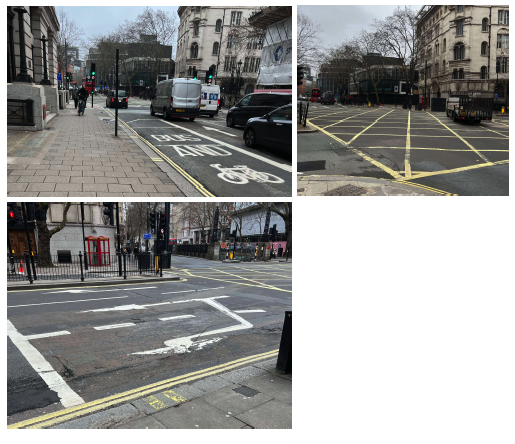
As with Collision Area one, this location represents a high-conflict meeting point, where multiple traffic streams meet and cross. A key additional complexity is the presence of a yellow box junction, governed by Rule 174 of the UK Highway Code, which prohibits vehicles from entering the box unless the exit lane is clear (with limited exceptions for right turns impeded by oncoming traffic).
In practice, drivers frequently misjudge the availability of exits and inadvertently stop within the yellow box. This often results in stressful, unplanned decision-making, including sudden braking, late lane changes, or evasive manoeuvres. Such driving poses a heightened risk to cyclists, who may be forced to make unplanned movements to avoid stationary or poorly positioned vehicles.
The risk is further compounded by directional lane markings immediately upstream of the junction. Motorists who realise late that they are positioned in an incorrect lane may attempt last-second corrections, including sharp lane changes or blocking adjacent lanes. These actions increase risks and reduce predictability for all road users.
Collision Area Three:
Location – Piccadilly Circus
What3Words – https://what3words.com/vent.studio.renew


This location is a major tourist hotspot, home to theatres and the iconic Piccadilly Circus digital advertising screens. The large illuminated displays can be a visual attraction and can distract drivers, riders, cyclists, and pedestrians alike. The area also features yellow box junctions, multiple signalised crossings, and a complex arrangement of traffic lanes with heavy turning movements.
Pedestrian activity is consistently high. While many crossings occur at designated points, non-compliant crossings are common, with people stepping into the carriageway between signals or dashing across gaps in traffic. As a popular visitor destination, the area also sees frequent taxi and private hire vehicle pick-ups and drop-offs, adding further stopping, pulling-in, and pulling-out manoeuvres along the kerbside.
All road users should expect continuous pedestrian pressure near crossings and unpredictable movements throughout the area. The visual stimulus from the large digital screens can reduce situational awareness, increasing the likelihood of late decision-making, such as pedestrians stepping forward and then hesitating, drivers braking abruptly, cyclists changing position to navigate through traffic, or vehicles making sudden lane changes.
Given the multi-lane approaches, irregular lane continuity, and heavy turning flows, careful lane selection and early positioning are essential. Maintaining appropriate following distances, moderating speed, scanning well ahead for emerging hazards, and anticipating last-minute movements from others will significantly reduce risk.
In a location as visually busy and dynamic as Piccadilly Circus, proactive observation and anticipation are far more effective than reacting at the last moment.
Collision Area Four:
Location – Trafalgar Square
What3Words – https://what3words.com/calm.crisis.names


Trafalgar Square, while lacking some of the intense visual distractions seen in other central London locations, remains a highly complex and dynamic traffic environment. The area accommodates significant volumes of cyclists, supported in part by a nearby cycle hire docking station. The King Charles I roundabout has minimal conventional lane markings, relying largely on painted destination wording on the carriageway, such as “PALL MALL” and “TRAF SQUARE.”
This limited lane definition can lead to inconsistent positioning, with some drivers, cyclists, and motorcyclists taking the shortest or most direct line through the circulatory lanes. As a result, lane cutting, late changes of direction, and lane drifting are very common. Vehicles exiting at the last moment or adjusting position mid-circulation can create sudden conflict points, particularly where traffic volumes are high.
Pedestrian flows are also significant. Large groups frequently gather and cross at the approaches to Whitehall, The Mall, and the Strand, creating intermittent but substantial interruptions to traffic movement.
All road users should treat the area as a low-speed, high-complexity environment. Maintaining generous space, selecting lanes early, avoiding late or unnecessary lane changes near entries and exits, and signalling clearly and in good time are essential.
Given the potential for poor lane discipline and last-second manoeuvres, anticipation and positioning are critical. Road users should remain prepared to giveway, stop, or adjust safely if boxed in, recognising that predictability and patience are key to navigating this busy landmark junction safely.
Collision Area Five:
Location – Whitechapel High Street
What3Words – https://what3words.com/banks.ruler.latter


Although this area is less congested than some of central London’s major tourist locations, it is still regarded as having a relatively high collision rate. The presence of a nearby Underground station increases pedestrian activity, particularly at peak travel times, while a yellow box junction and converging turning movements add complexity to vehicle flows.
Pedestrians emerging from the station may be distracted, unfamiliar with the area, or focused on devices, leading to sudden crossings or hesitation at the kerbside. At the junction itself, vehicles may enter the yellow box without a clear exit path, resulting in last-minute braking, blocking of cross traffic, or erratic manoeuvres when drivers attempt to clear the space. The area also experiences regular movements from cyclists and motorcyclists, who may filter through traffic or adjust their road position to navigate around stationary vehicles.
All road users should approach this location with heightened awareness. Observing junction discipline, only entering the yellow box when the exit is clear, maintaining safe following distances, and anticipating sudden pedestrian or two-wheeler movements are essential. A measured speed, clear signalling, and readiness to give way where necessary will help reduce conflict and improve overall safety in this area.
Thoughts to consider across all five areas:
Across all five locations, a consistent theme emerges: collision risk in London is driven less by the complexity of the rules themselves and more by human behaviour within dense, mixed-use environments. These sites are not anomalies; they reflect the everyday conditions of central London, where pedestrian, cyclist, rider, and vehicle movements constantly overlap.
Several common risk factors are evident:
1. High pedestrian volumes, including tourists and Underground users who may be unfamiliar with the area, are distracted by devices, or uncertain about where to cross.
2. Complex junction layouts and yellow box junctions, where exit space can be misjudged, leading to blocked junctions, sudden braking, or reactive manoeuvres.
3. Inconsistent or ambiguous lane discipline, particularly where road markings are limited or where cyclists and motorcyclists adopt practical road positions that differ from painted guidance.
4. Frequent pick-up and drop-off activity, sometimes informal or marginally compliant, introduces additional stopping, merging, and kerbside friction.
5. Environmental distractions, such as digital advertising screens, theatres, and crowd activity, can reduce overall situational awareness for everyone.
Taken together, these factors create environments where unpredictability is the primary hazard. For all road users, the most effective safety strategy is not simply rule compliance, but anticipation, recognising that others may hesitate, misjudge, filter, drift, or change direction unexpectedly.
In central London, patience, clear communication, disciplined positioning, and defensive awareness are essential to managing shared space safely.