
Running for around 190 miles from London to Leeds, the M1 is one of Britain’s most important motorways. It passes through Hertfordshire, Bedfordshire, Northamptonshire, Leicestershire, Nottinghamshire, Derbyshire and South Yorkshire.
With commuters, HGVs and long-distance traffic sharing the motorway every day, conditions can change quickly. Congestion, sudden braking, busy interchanges, lane changes and driver fatigue are among the main risks.
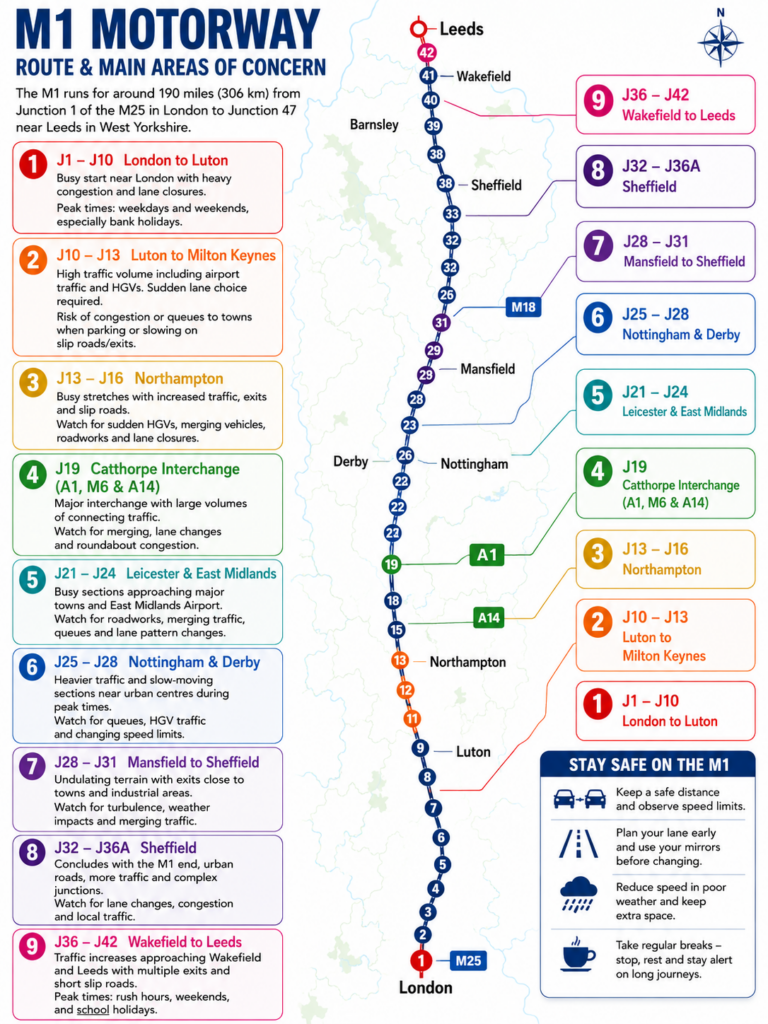
Where should drivers take extra care?
J1–J10 – London to Luton
The southern end of the M1 carries heavy traffic travelling between London, the M25, Watford and Luton. Congestion can build rapidly, particularly around major junctions and during peak commuting periods.
Main risks: heavy traffic, sudden queues, frequent lane changes and following too closely.
J10–J13 – Luton to Milton Keynes
This is another heavily travelled section, carrying a mixture of local commuters, airport traffic, HGVs and long-distance motorists. Drivers need to watch well ahead because traffic speeds can change significantly.
Main risks: congestion, sudden braking and vehicles joining or leaving at busy junctions.
J15–J16 – Northampton
The M1 around Northampton is an important junction area with significant local and long-distance traffic. Queues near junctions can cause vehicles travelling at motorway speeds to encounter much slower traffic with little warning.
Main risks: queuing traffic, merging vehicles and rear-end collisions.
J19 – Catthorpe Interchange
Junction 19 is one of the M1’s most important interchanges, connecting the M1, M6 and A14. Large numbers of vehicles change routes here, including substantial HGV traffic. Drivers should follow signs early and avoid sudden lane changes when approaching the interchange.
Main risks: merging traffic, HGVs, lane changing and congestion.
J21–J24 – Leicester & East Midlands
The motorway becomes particularly busy around Leicester, the M69 interchange and approaches to East Midlands Airport. Junction 23A also provides access towards the A42, adding to the amount of joining and leaving traffic.
Main risks: busy junctions, merging traffic, queues and sudden changes in speed.
J25–J28 – Nottingham & Derby
This central section of the M1 carries large amounts of commuter and commercial traffic. Traffic around the Nottingham and Derby approaches can become congested, particularly during weekday peak periods.
Main risks: congestion, HGV traffic, lane changing and sudden braking.
J28–J31 – Mansfield to Sheffield
Further north, gradients and changing weather can add to the challenge, particularly in heavy rain, fog or winter conditions. Drivers should allow additional space around HGVs and reduce their speed when visibility deteriorates.
Main risks: poor weather, spray, HGVs and changing traffic speeds.
J32–J35A – Sheffield
The M1 around Sheffield connects with several major routes, including the M18 at Junction 32. This creates substantial merging and long-distance traffic, while busy junctions serving Sheffield can lead to queues.
Main risks: merging traffic, congestion and last-minute lane changes.
J39–J42 – Wakefield to Leeds
Approaching the northern end of the M1, traffic levels increase again around Wakefield and Leeds. Junctions connecting with the M62 and other major routes mean motorists need to pay close attention to signs and choose the correct lane early.
Main risks: busy interchanges, queues, lane changing and driver fatigue.
Staying Safe on the M1
A clear motorway can become congested within minutes. Drivers should maintain a safe following distance, watch several vehicles ahead for brake lights and move into the correct lane well before their junction. Poor weather should also be taken seriously. Heavy rain, spray, fog and ice can dramatically increase stopping distances and reduce visibility.
For motorists travelling much of the M1’s full length, fatigue is another major concern. Take regular breaks rather than continuing when concentration begins to fall.
The key areas to remember
J1–J10: London, M25 and Luton traffic
J10–J13: congestion and changing traffic speeds
J15–J16: Northampton junction traffic
J19: M1/M6/A14 interchange
J21–J24: Leicester and East Midlands traffic
J25–J28: Nottingham and Derby congestion
J28–J31: weather, gradients and HGV traffic
J32–J35A: Sheffield and M18 interchange
J39–J42: Wakefield and Leeds traffic
The M1 is designed to move huge numbers of vehicles efficiently, but its busiest sections demand concentration. Keeping your distance, anticipating queues and planning lane changes early can make every M1 journey safer.