
Running from north-east London to Cambridge, the M11 is a vital route for commuters, airport passengers, HGVs and long-distance traffic travelling through Essex and Cambridgeshire.
The motorway connects with the M25 at J6, serves Stansted Airport at J8, and finishes at J14 near Cambridge, where it meets the A14. Although much of the M11 is relatively open compared with motorways such as the M1 and M25, conditions can change quickly. Congestion, airport traffic, busy junctions, sudden queues and driver fatigue all require attention.
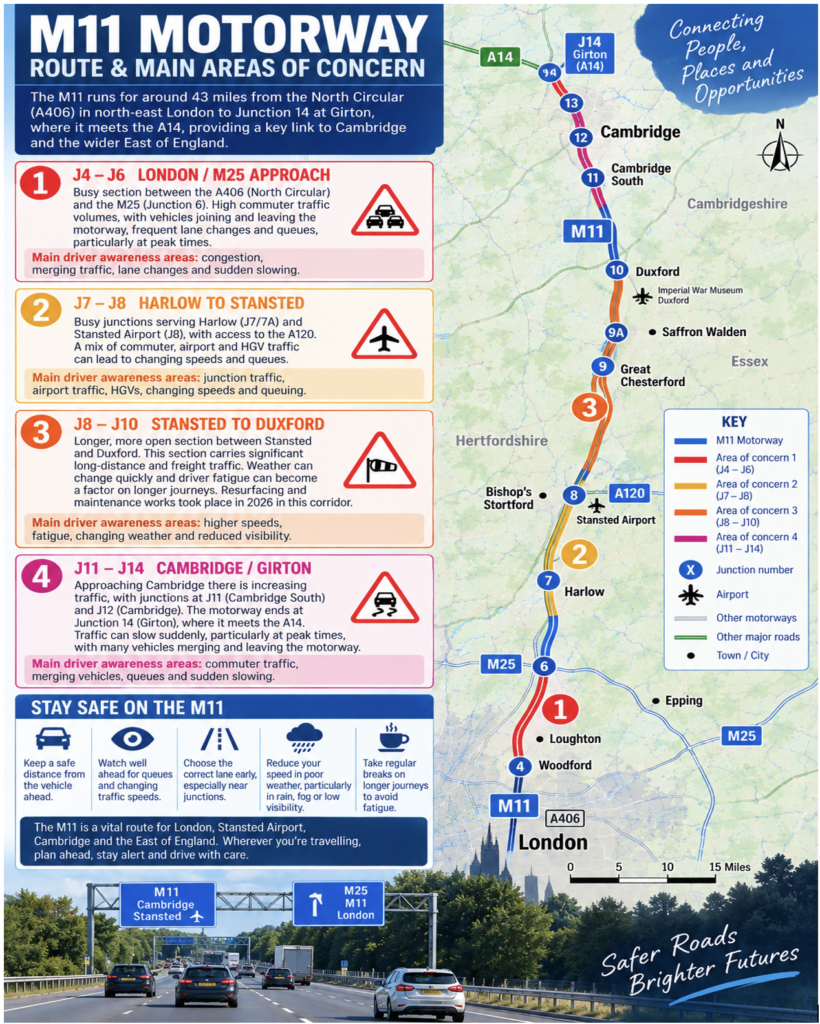
J4–J6 – London & M25 Approach
The southern section carries heavy commuter traffic between London, Essex and the M25. Traffic joining and leaving around busy junctions can result in rapid changes in speed, particularly during peak periods.
Main risks: congestion, merging traffic, frequent lane changes and sudden braking.
J7–J8 – Harlow to Stansted
This is one of the M11’s busiest junction areas. J7 and J7A serve Harlow, while J8 connects with the A120 and provides access to Stansted Airport. Airport passengers share the motorway with commuters, HGVs and long-distance traffic, increasing the amount of joining and leaving traffic.
National Highways has also carried out specific safety improvements between J7 and J8.
Main risks: airport traffic, HGVs, queues, merging vehicles and changing traffic speeds.
J8–J10 – Stansted to Duxford
North of Stansted, the motorway becomes more rural, and traffic can travel for longer periods at higher speeds. This makes concentration particularly important. Poor weather can quickly reduce visibility, while fatigue can become a factor for drivers making longer journeys.
National Highways carried out resurfacing and maintenance along this corridor during 2026, including work between J8 and J9A.
Main risks: speed, fatigue, poor weather and reduced visibility.
J10–J14 – Duxford & Cambridge
Approaching Cambridge, traffic levels increase again.
J10 serves Duxford, while J11 and J12 provide important access to Cambridge. At the northern end, J14 at Girton connects the M11 with the A14, creating an important interchange for traffic travelling towards Huntingdon, the Midlands and East Anglia.
National Highways describes the A14 around Cambridge as carrying substantial commuter and long-distance traffic and providing the strategic connection between the A1 and M11.
Main risks: commuter traffic, merging vehicles, queues and sudden changes in speed.
Staying Safe on the M11
A relatively clear M11 can become congested surprisingly quickly, particularly around the M25, Harlow, Stansted and Cambridge. Drivers should keep a safe following distance, watch well ahead for brake lights and choose the correct lane early when approaching junctions.
Take extra care around Stansted Airport, where motorists unfamiliar with the route may make sudden lane changes.
In heavy rain, fog or poor visibility, reduce speed and increase the distance to the vehicle ahead. Longer-distance drivers should also take regular breaks rather than continuing when tired.
Key areas to remember
J4–J6: London and M25 traffic
J7–J8: Harlow and Stansted Airport
J8–J10: long-distance traffic, weather and fatigue
J10–J14: Duxford, Cambridge and A14 traffic
The M11 provides an essential connection between London, Stansted Airport, Cambridge and the East of England. Keeping your distance, anticipating queues and pla