
The M2 runs for around 26 miles through Kent, beginning near Strood and Rochester and ending at Junction 7 near Faversham, where it connects with the A2.
Although considerably shorter than motorways such as the M1, M4 and M5, the M2 is an important route towards Medway, Canterbury, Dover and the Kent coast. Busy junctions, commuter traffic and vehicles heading towards the Channel ports can all create challenging conditions.
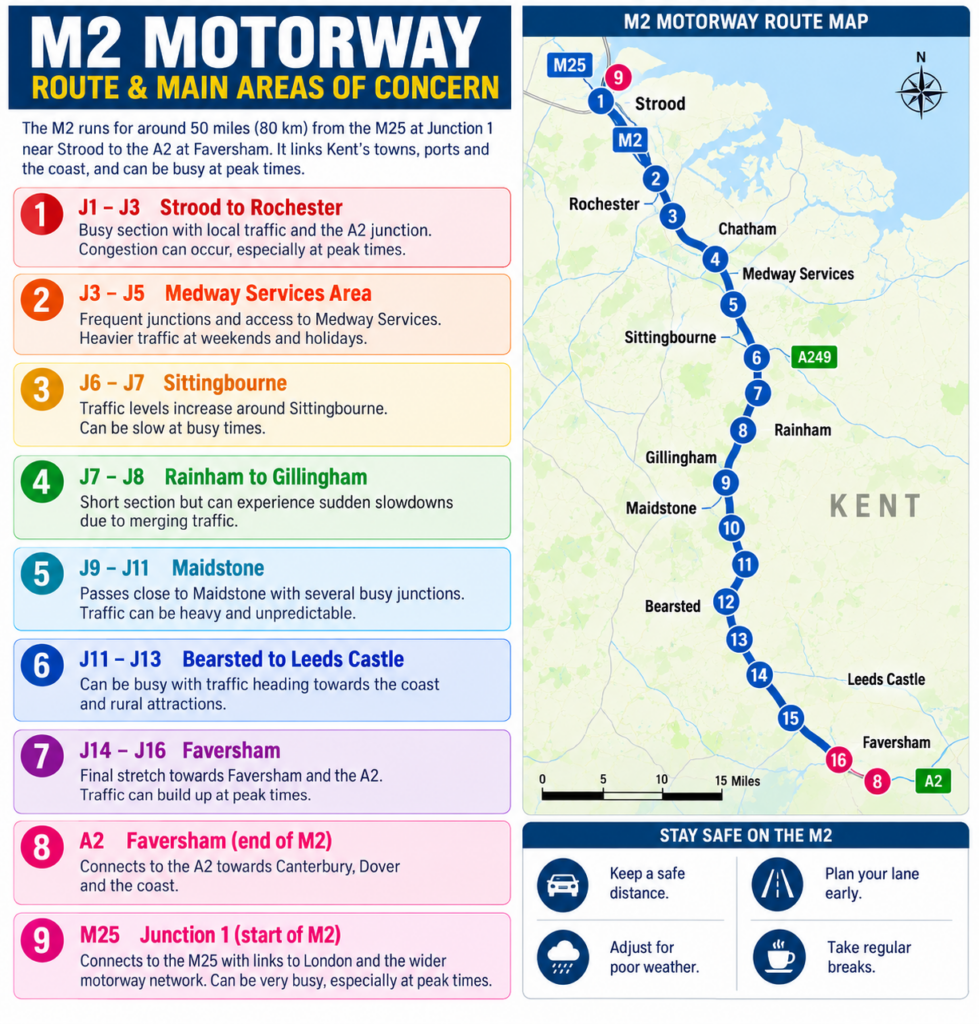
Where should drivers take extra care?
J1–J2 – Strood & Rochester
The western end of the M2 carries traffic between the A2, Medway towns and wider motorway network. The approach to Junction 2 can become particularly busy as vehicles join, leave and change lanes.
Main risks: congestion, merging traffic and sudden braking.
J2–J3 – Medway
This section carries significant local and longer-distance traffic. Drivers should watch for queues developing around junction approaches, especially during busy commuting periods.
Main risks: changing traffic speeds, lane changes and following too closely.
J3–J4 – Chatham & Gillingham
Junction 3 provides an important connection with the A229 towards Maidstone, while Junction 4 serves the Medway area. Traffic joining and leaving the motorway can lead to sudden changes in speed.
Main risks: busy slip roads, merging vehicles and unexpected queues.
J4–J5 – Sittingbourne
The M2 becomes more rural as it continues east, but drivers should not allow the quieter surroundings to reduce their concentration. Rain, spray and poor visibility can make motorway driving considerably more difficult.
Main risks: speed, poor weather and loss of concentration.
J5–J7 – Faversham & Brenley Corner
The eastern end of the motorway is particularly important for traffic continuing towards Canterbury, Dover and the Channel ports. At Junction 7, the motorway ends and traffic continues onto the A2. Drivers unfamiliar with the route should pay close attention to signs and position themselves correctly well in advance.
Main risks: heavy long-distance traffic, HGVs, lane changes and congestion.
Staying Safe on the M2
Despite its relatively short length, conditions on the M2 can change quickly. Drivers should keep a safe distance, watch ahead for brake lights, plan lane changes early and reduce speed in heavy rain or poor visibility.
Key areas to remember
J1–J2: Strood and Rochester traffic
J2–J3: busy Medway corridor
J3–J4: A229 and Medway junction traffic
J4–J5: speed and changing weather
J5–J7: Faversham, A2 and Channel-bound traffic
The M2 may be short, but it carries an important mixture of commuter, freight and long-distance traffic. Staying alert, leaving plenty of space and anticipating changing traffic conditions can make every journey safer.