
The M23 may be one of Britain’s shorter motorways, but it carries a surprisingly demanding mixture of traffic. Connecting the M25 with Gatwick Airport, Crawley and the A23 towards Brighton, it is a vital route for commuters, airport passengers, commercial vehicles and motorists travelling between London and the South Coast.
For much of its length, the M23 can appear relatively straightforward. However, heavy traffic, major interchanges, airport-bound drivers, frequent lane changes and sections of all-lane-running motorway mean conditions can change quickly.
For drivers who use the route regularly, or are heading to Gatwick or Brighton for the first time, several areas require extra concentration.
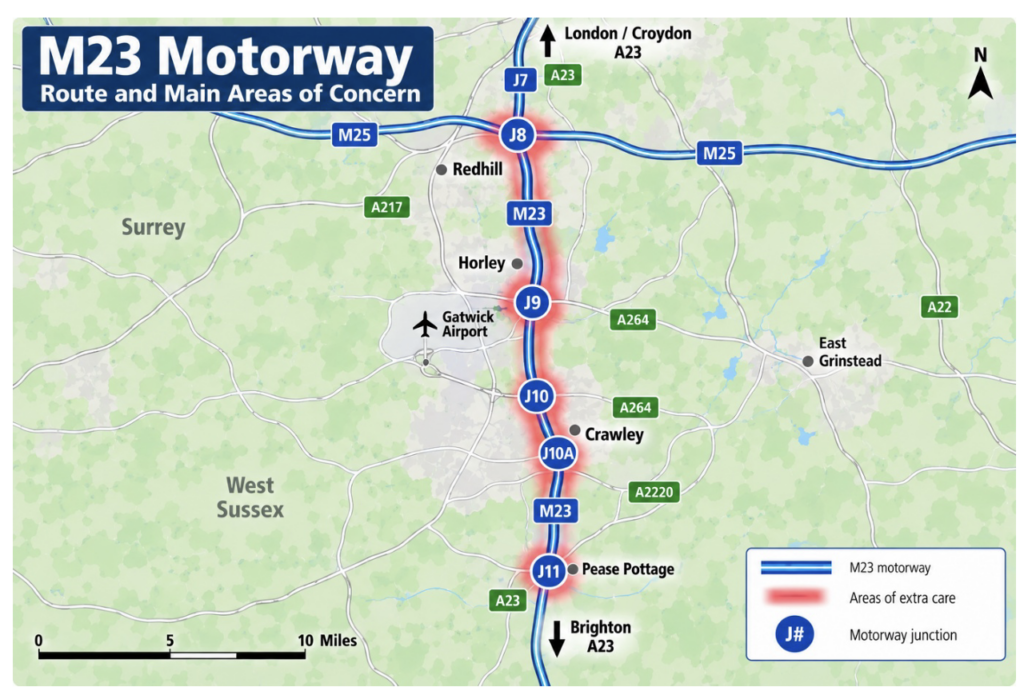
J7–J8: London Approach and the M25
At its northern end, the M23 continues towards London via the A23, while Junction 8 provides the major connection with the M25. This is one of the most important interchanges on the route. Traffic travelling between the M23 and M25 can produce considerable merging and lane-changing activity, particularly during busy commuting periods.
Drivers approaching J8 should read signs early and move into the appropriate lane in good time. Last-minute lane changes are particularly risky around large motorway interchanges because other motorists may also be changing position.
Traffic can also slow quickly on the approach to the M25. A generous following distance gives you more time to react if vehicles ahead suddenly brake.
J8–J9: M25 to Gatwick Airport
South of the M25, the M23 becomes the principal motorway approach to Gatwick Airport. This section carries commuters alongside airport passengers, taxis, coaches, HGVs and other commercial vehicles. Some motorists may be unfamiliar with the route and concentrating heavily on signs for airport terminals and surrounding roads.
That can result in unexpected lane changes or sudden reductions in speed.
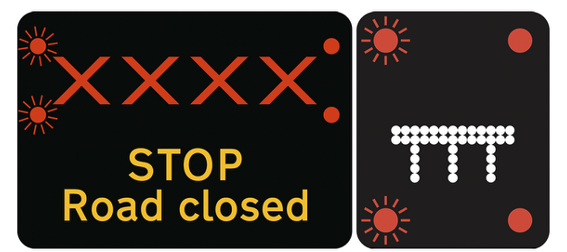
The section between J8 and J10 operates with all lanes available for normal traffic rather than having a conventional permanent hard shoulder. Drivers therefore need to pay close attention to electronic signs, variable speed limits and lane-closure signals.
A red X above a lane means that lane is closed. Drivers must not continue in it.
Junction 9: Gatwick Airport
Junction 9 is arguably the M23’s most distinctive junction, providing the main motorway access towards Gatwick Airport. Airport traffic creates challenges that are slightly different from those found on an ordinary commuter motorway.
Drivers may be visiting the area for the first time, following sat-nav instructions, looking for terminal signs or worrying about flight times. Coaches, taxis, private-hire vehicles and passengers being collected or dropped off add to the mixture. During busy holiday periods, early mornings and major travel days, the volume of airport-related traffic can increase substantially.
The safest approach is simple: know which exit you need before reaching the junction, follow signs early and avoid cutting across lanes at the last moment.
If you miss an exit, continue safely and allow your navigation system to redirect you rather than making a dangerous manoeuvre.
J9–J10: Gatwick to Crawley
Between Gatwick and Crawley, traffic making relatively short local journeys mixes with vehicles travelling much farther between London and the South Coast.
This creates frequent joining and leaving movements.
Because Gatwick and Crawley are so close together, drivers can encounter another junction soon after passing the airport. Maintaining a safe distance is particularly important because traffic ahead may brake as motorists position themselves for their exits. Wet weather makes this even more important. At motorway speeds, stopping distances increase considerably on wet roads.
Junction 10: Crawley and East Grinstead
Junction 10 serves Crawley and routes towards East Grinstead, making it another busy point on the M23. Local commuter traffic can add to the motorway’s longer-distance traffic, particularly around the beginning and end of the working day. Watch carefully for vehicles joining the motorway and avoid remaining unnecessarily alongside another vehicle when approaching slip roads. Creating space can make it easier for joining traffic to merge safely.
Drivers leaving at J10 should also move into position early rather than waiting until they are close to the exit.
Junction 10A: Crawley
J10A provides further access to the Crawley area. The relatively short distances between the Gatwick and Crawley junctions mean this part of the motorway can involve repeated joining, leaving and lane-changing movements.
Rather than concentrating only on the vehicle directly ahead, look well down the motorway. Brake lights several vehicles ahead can warn you early that traffic is beginning to slow.
Junction 11: Pease Pottage and the End of the M23
The M23 reaches its southern end around Junction 11 at Pease Pottage, where the route continues as the A23 towards Brighton.
This is an important transition point.
Although drivers continuing towards Brighton remain on a major dual carriageway, they are no longer travelling on the M23. Junction layouts, traffic patterns and surrounding roads change as motorists continue south. Traffic towards Brighton and the Sussex coast can become particularly heavy during summer weekends, bank holidays and major events.
Drivers should remain alert rather than treating the end of the motorway as the end of the demanding part of the journey.
All-Lane-Running Safety on the M23
One of the most important things motorists should understand about the M23 is the all-lane-running section between Junctions 8 and 10. On this section, there is no conventional permanent hard shoulder available along the entire route. Emergency areas are provided for vehicles experiencing difficulties.
If your vehicle develops a problem, leave the motorway at the next junction if it is safe and possible to do so. If you cannot, try to reach an emergency area. If you have to stop unexpectedly, prioritise getting yourself and your passengers to the safest possible location, then contact emergency services or National Highways as appropriate.
Drivers passing a stranded vehicle should pay close attention to overhead signs and lane closures.
Weather Can Transform the M23
Poor weather can make an already busy motorway significantly more challenging. Heavy rain reduces visibility and increases stopping distances. Spray from HGVs can temporarily obscure vehicles ahead, while standing water can increase the risk of losing control.
Fog can also affect the Gatwick and surrounding areas.
In poor conditions, reduce your speed, increase the distance between you and the vehicle ahead and use your lights appropriately.
The normal two-second following gap in dry conditions should be at least doubled in wet weather and increased further when visibility is poor.
Give HGVs Extra Space
Commercial traffic forms an important part of the traffic using the M23. Large vehicles have significant blind spots and require considerably more distance to stop than a car. Avoid travelling alongside an HGV unnecessarily, particularly near junctions where the driver may need to change lanes. If you cannot see the vehicle’s mirrors, there is a good chance its driver cannot see you.
When an HGV moves out to overtake, resist the temptation to close the gap aggressively. Giving larger vehicles room helps everyone maintain a safer traffic flow.
Five Areas Where Extra Care Matters Most
For motorists travelling the full M23, the sections deserving particular attention are:
J8 – M25 interchange: Heavy merging traffic and significant lane-changing movements.
J8–J10: All-lane-running motorway where drivers must pay particular attention to electronic signs and red-X lane closures.
J9 – Gatwick Airport: Airport traffic, coaches, taxis and unfamiliar drivers can increase sudden lane changes.
J10–J10A – Crawley: Busy local junctions combined with longer-distance motorway traffic.
J11 – Pease Pottage: The M23 ends, and traffic continues onto the A23 towards Brighton.
A Short Motorway That Still Demands Respect
At first glance, the M23 may seem less intimidating than motorways such as the M1, M6 or M25. Its relatively short length, however, should not encourage complacency.
Within a comparatively short journey, a driver can encounter a major M25 interchange, an all-lane-running section, one of Britain’s busiest airports, several Crawley junctions and the transition onto the A23 towards Brighton.
The key to using the M23 safely is anticipation.
Keep a safe distance, watch well ahead, plan lane changes early, obey overhead signs and give yourself additional time when travelling to Gatwick.
A few extra seconds of planning can make the difference between a calm motorway journey and a dangerous last-minute manoeuvre.