
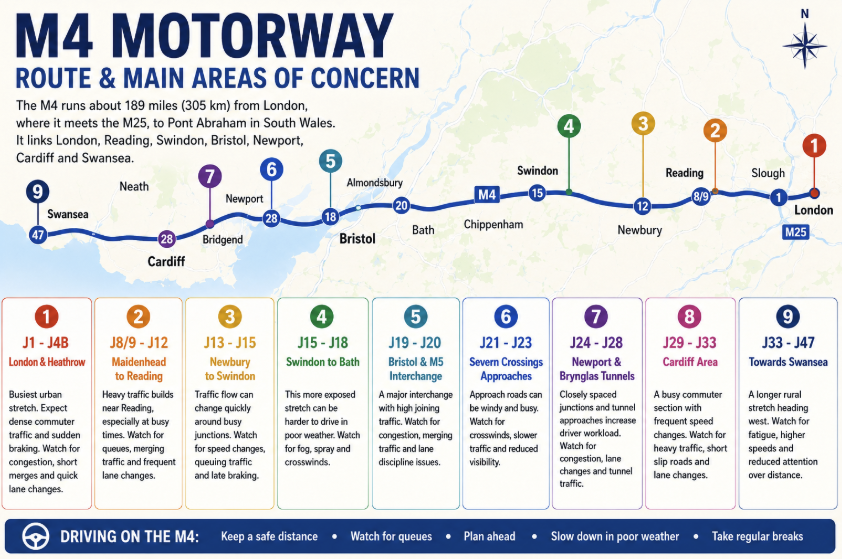
Running from West London to South Wales, the M4 is one of the UK’s busiest and most important motorways. It passes Heathrow, Reading, Swindon, Bristol and Newport before continuing towards Cardiff and Swansea.
For much of its route, the M4 is straightforward, but heavy traffic, complex junctions, changing speed limits, and poor weather can make certain sections more demanding.
Where should drivers take extra care?
J1–J4B – West London & Heathrow
The eastern end of the M4 carries extremely heavy traffic, with vehicles travelling between London, Heathrow Airport and the M25. Traffic speeds can change quickly, particularly during commuting periods and around airport traffic.
Main risks: congestion, sudden braking, frequent lane changes and closely following traffic.
J8/9–J12 – Maidenhead to Reading
This busy Berkshire section combines long-distance motorway traffic with large numbers of local commuters. The approaches to Reading can become congested, meaning drivers travelling at motorway speeds may suddenly encounter slower or stationary traffic.
Main risks: queues, rear-end collisions and vehicles changing lanes near junctions.
J13–J15 – Newbury to Swindon
The M4 becomes more rural west of Reading, which can create a different danger: drivers may become comfortable with lighter traffic and higher cruising speeds. Junction approaches can still produce sudden changes in traffic flow.
Main risks: speed, loss of concentration and unexpected queues.
J15–J18 – Swindon to Bath
This section carries substantial long-distance traffic travelling between London, the South West and South Wales. Weather can also become a factor, with heavy rain and spray significantly reducing visibility.
Main risks: high-speed traffic, poor weather, HGVs and driver fatigue.
J19–J20 – Bristol & M5 Interchange
One of the most important sections of the M4 is around Junction 20, where it meets the M5 at Almondsbury. Large volumes of traffic merge and change lanes as motorists choose between Bristol, South Wales, the Midlands and the South West. Drivers should read signs early and avoid making sudden last-minute lane changes.
Main risks: merging traffic, congestion, lane changing and sudden braking.
J21–J23 – Approach to the Prince of Wales Bridge
Traffic heading towards or from South Wales can become particularly heavy around the motorway approaches to the Severn crossings. Strong winds, heavy rain and poor visibility can also make conditions more difficult.
Main risks: changing weather, crosswinds, congestion and high traffic volumes.

Newport – J24–J28
The M4 around Newport is one of the most demanding parts of the route.
Closely spaced junctions, busy commuter traffic, gradients and frequent congestion mean drivers need to remain particularly alert. The motorway also passes through the Brynglas Tunnels between J25 and J26, where traffic can slow rapidly.
Main risks: congestion, tunnels, merging traffic and sudden changes in speed.
Cardiff – J29–J33
Traffic levels increase again around Cardiff, particularly during weekday commuting periods and major sporting or entertainment events. Motorists unfamiliar with the area should choose their lane early rather than attempting to cross several lanes close to an exit.
Main risks: heavy traffic, queues and last-minute lane changes.
J33 onwards – Towards Swansea
West of Cardiff, the motorway generally becomes less urban, but long journeys bring another significant motorway danger: driver fatigue. A driver travelling from London to South Wales may already have spent several hours behind the wheel.
Main risks: tiredness, loss of concentration, speed and poor weather.
Staying Safe on the M4
The M4 can change from a clear motorway to slow-moving traffic remarkably quickly.
Drivers should maintain a safe following distance, look well ahead for brake lights, move into the correct lane early and reduce speed when visibility or weather deteriorates.
Regular breaks are also important on longer journeys, particularly when travelling the full route between London and South Wales.
The key areas to remember
J1–J4B: London and Heathrow congestion
J8/9–J12: busy Reading corridor
J15–J18: long-distance traffic and fatigue
J19–J20: M4/M5 interchange and merging traffic
J21–J23: Severn crossing approaches and weather
J24–J28: Newport and Brynglas Tunnels
J29–J33: Cardiff congestion
The M4 is a vital motorway connecting London, southern England and South Wales. Giving yourself space, anticipating queues and staying alert around its busiest junctions can make the journey considerably safer.