
The M40 is one of Britain’s most important motorway routes, connecting London and the South East with Oxfordshire, Warwickshire, Birmingham and the wider Midlands. Stretching for approximately 89 miles, it carries a busy mixture of commuters, HGVs, business travellers and holiday traffic.
Although much of the M40 passes through open countryside, drivers should not underestimate its potential hazards. Fast-moving traffic, steep gradients through the Chiltern Hills, major motorway interchanges and sudden congestion can all make the route demanding.
From the busy approaches to the M25 near London to the rural stretches around Oxfordshire and the M42 interchange near Birmingham, the M40 presents different challenges along its length.
For motorists travelling the entire motorway or simply using it for a short journey, understanding where extra care is needed can make a significant difference to safety.
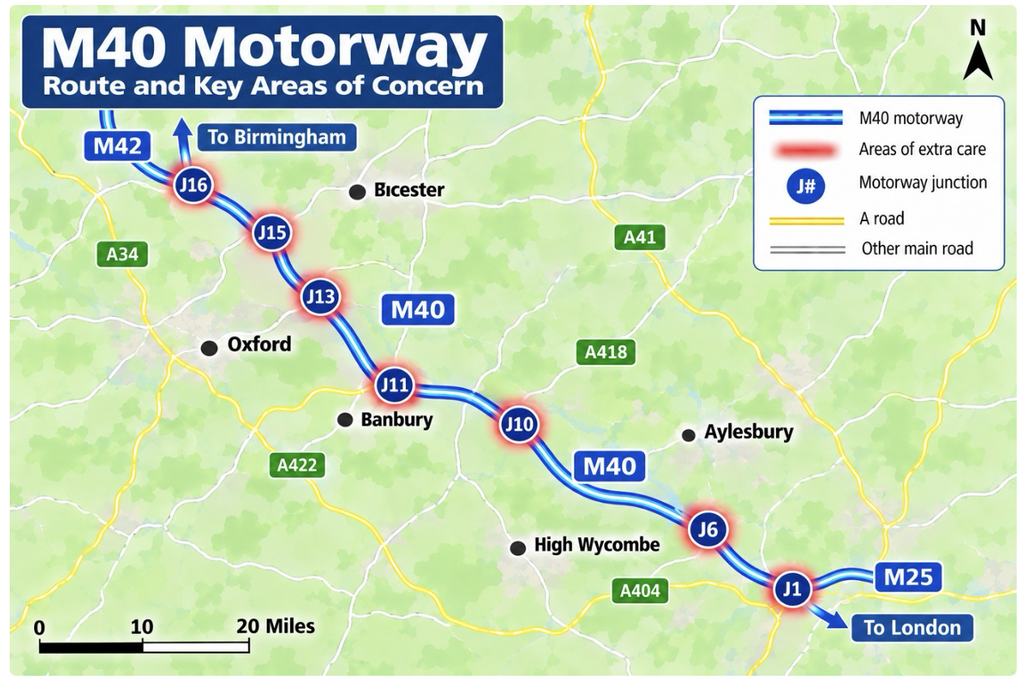
Main Areas of Concern on the M40
Junction 1–1A – Uxbridge and the M25 Interchange
The southern end of the M40 begins near Uxbridge, where it connects with the A40 towards London. Junction 1A provides the major interchange with the M25. This is one of the busiest and most important connections on the route, carrying traffic travelling between London, Heathrow, the M25 and the Midlands. Drivers may encounter heavy merging traffic, sudden braking and vehicles changing lanes to reach their intended motorway.
During peak commuting periods, congestion can develop quickly, particularly where traffic joins from surrounding routes.
Safety advice: Check direction signs early, maintain a generous following distance and avoid last-minute lane changes when approaching the M25 interchange.
Junctions 2-4 – Beaconsfield and High Wycombe
The M40 continues northwest through Buckinghamshire, passing Beaconsfield and High Wycombe. This section combines local commuter traffic with long-distance vehicles travelling towards Oxford and Birmingham.
Junction 4 at Handy Cross, near High Wycombe, is particularly important because it connects with several local and regional routes, including the A404 towards Marlow and the M4 corridor. Vehicles joining and leaving the motorway can create significant changes in traffic speed, especially during busy periods.
The surrounding Chiltern landscape also introduces hills and gradients that require additional attention.
Safety advice: Watch for vehicles braking near exits, allow extra room around HGVs and avoid travelling unnecessarily close to other vehicles on downhill sections.
Junctions 5–6 – Stokenchurch and Lewknor
Between High Wycombe and Lewknor, the M40 crosses the Chiltern Hills. This is one of the most distinctive stretches of the motorway, with steep gradients, elevated sections and surrounding countryside. The Stokenchurch cutting and the descent towards the Lewknor area deserve particular attention. Long downhill sections can increase vehicle speeds if drivers fail to monitor their speedometers. HGVs may also travel at different speeds when climbing or descending gradients.
During winter, low temperatures, fog and wet road surfaces can make conditions more challenging.
Safety advice: Keep your speed under control on descents, maintain additional space and anticipate slower-moving heavy vehicles on uphill stretches.
Junctions 7–8A – Wheatley and Oxford
As the M40 approaches Oxfordshire, it passes through a mixture of rural countryside and important regional connections. Junction 7 serves the Wheatley area, while Junction 8 and Junction 8A provide connections involving the A40 and A418 towards Oxford, Thame and surrounding communities. Drivers unfamiliar with the road layout may need to make decisions about their onward route over a relatively short distance.
Traffic heading towards Oxford can become particularly busy during commuting periods, university travel days and major events.
Safety advice: Follow signs carefully, plan your exit well in advance and avoid sudden lane changes when approaching the Oxford connections.
Junctions 9–10 – Bicester and Cherwell Valley
Junction 9 is one of the M40’s major regional connections, providing access to the A34 towards Oxford and the south, as well as the A41 towards Bicester. This interchange carries a mixture of local traffic, long-distance motorists and freight vehicles. The A34 is an important north-south route, meaning the junction can experience substantial HGV movements.
Further north, Junction 10 serves the Cherwell Valley area and nearby routes. Congestion can develop around these junctions when traffic volumes are high or incidents affect the surrounding road network.
Safety advice: Expect vehicles changing lanes near the A34 interchange and maintain sufficient space for larger vehicles to merge.
Junction 11 – Banbury
Junction 11 provides access to Banbury and the A422, making it an important junction for local commuters and commercial traffic. The area serves businesses, industrial estates and surrounding communities, creating a mixture of short local journeys and long-distance motorway traffic.
During busy periods, traffic may slow as vehicles leave the motorway or join from the slip roads. Drivers travelling north towards Warwickshire should remain alert to changes in traffic speed around the junction.
Safety advice: Watch for queues approaching the exit, check mirrors regularly and avoid sudden braking.
Junctions 12–15 – Gaydon, Warwick and Leamington Spa
The northern section of the M40 passes through Warwickshire, serving Gaydon, Warwick, Leamington Spa and surrounding communities. Junction 12 provides access towards Gaydon, while Junction 15 connects with the A46 near Warwick.
This section carries commuter traffic alongside freight and long-distance vehicles travelling between London and the Midlands. The A46 interchange at Junction 15 is particularly important because it provides access towards Coventry, Stratford-upon-Avon and other regional destinations.
Motorists should be prepared for vehicles positioning themselves for exits and traffic speeds changing near the major junctions.
Safety advice: Leave plenty of room around joining vehicles and plan lane changes early, particularly around Junction 15.
Junction 16 – M42 Interchange and Birmingham Approach
The northern end of the M40 connects with the M42 at Junction 16, providing onward routes towards Birmingham, the West Midlands and the wider motorway network. This is a major interchange where long-distance traffic transfers between two important motorways.
Drivers may encounter heavy HGV traffic, busy merging movements and sudden reductions in speed as vehicles approach the M42. During peak periods, congestion can affect traffic travelling towards Birmingham and other parts of the Midlands.
Safety advice: Read overhead and roadside signs early, avoid unnecessary lane changes and maintain a safe following distance when approaching the interchange.
Why Some Parts of the M40 Have Raised Road Safety Concerns
The M40’s safety challenges are not based solely on its reputation as a busy motorway. In its route strategy, National Highways identified two stretches where collisions involving people killed or seriously injured had been recorded and where further safety investigation was warranted. These were the Wooburn Moor to Stokenchurch section and the Bicester to Warwick section.
Wooburn Moor to Stokenchurch – Junctions 3–5
This stretch includes the busy Handy Cross interchange at Junction 4 and the changing gradients approaching Stokenchurch. National Highways highlighted concerns about collisions, delays and freight movements in this area.
Drivers should be especially careful when traffic begins to slow around High Wycombe and when approaching downhill sections through the Chilterns.
Bicester to Warwick – Junctions 9–15
National Highways also identified safety concerns along the Bicester to Warwick corridor, particularly around Junctions 9–10 near Bicester and Junctions 14–15 near Warwick. The report highlighted seasonal delays around Bicester and Cherwell Valley, along with recorded serious collisions in the wider corridor.
These findings do not mean that every junction in these sections is equally dangerous, but they reinforce the importance of maintaining concentration and anticipating traffic conditions.
Weather Hazards on the M40
The M40 passes through a variety of landscapes, from the built-up outskirts of London to exposed countryside in Buckinghamshire, Oxfordshire and Warwickshire.
During winter, fog, frost and heavy rain can create particularly challenging conditions. The Chiltern Hills section around Stokenchurch and Lewknor deserves extra care because changing gradients can make slippery conditions more difficult to manage. Heavy rain can also create spray from HGVs, reducing visibility and making it harder to judge the distance to vehicles ahead.
Motorists should reduce their speed when conditions deteriorate, avoid harsh braking and increase their following distance.
The recommended two-second gap in dry weather should be at least doubled on wet roads, with significantly more space needed in icy conditions.
HGVs, Overtaking and Lane Discipline
The M40 is a major freight route between London, the Midlands and other parts of the country. HGVs may travel considerably more slowly on uphill sections, while vehicles overtaking them can create differences in speed between lanes. Drivers should avoid sitting unnecessarily alongside large vehicles and remember that lorries have significant blind spots.
Keep left unless overtaking, check mirrors and blind spots before changing lanes, and never move into a gap that leaves another driver insufficient stopping distance.
National Highways specifically advises motorway users to keep left unless overtaking and to remain within the posted speed limit.
Motorway Breakdowns – What Drivers Should Know
Breaking down on a fast-moving motorway can be dangerous, particularly on sections where traffic is travelling at high speed, or visibility is poor. If your vehicle develops a problem, try to reach the next motorway exit or service area if it is safe to continue.
If you cannot leave the motorway, move as far left as possible to a suitable place of relative safety and switch on your hazard warning lights. Where it is safe to exit the vehicle, use the doors away from traffic and move behind a safety barrier. If you are stopped in a live lane or cannot safely get out, remain inside with your seatbelt fastened and call 999.
Never place a warning triangle on a motorway.
These precautions follow the Highway Code’s guidance for motorway breakdowns.
Understanding Motorway Signs and Speed Limits
When approaching congestion, roadworks or an incident, drivers may encounter electronic warning signs and temporary speed restrictions. Variable speed limits displayed inside a red circle are legally enforceable.
A red X means the lane is closed, even if the road ahead appears clear. Driving in a lane closed by a red X is illegal and can put emergency workers and other motorists at risk.
Seven Essential Safety Tips for the M40
- Take extra care around Junctions 1A, 4, 9 and 15. These are important interchanges where merging traffic and changing speeds require attention.
- Control your speed through the Chiltern Hills. Gradients around Stokenchurch and Lewknor can make speed management more demanding.
- Maintain a safe following distance. Leave at least two seconds in dry weather and more when conditions deteriorate.
- Give HGVs additional space. Be particularly careful when overtaking large vehicles on hills.
- Watch for sudden queues. Traffic can slow rapidly around High Wycombe, Bicester, Banbury and Warwick.
- Check your vehicle before a long journey. Inspect tyres, fluids, lights and fuel levels.
- Take regular breaks. Long, relatively uninterrupted stretches of motorway can encourage fatigue and reduced concentration.
The Bottom Line – A Major Motorway That Demands Concentration
The M40 provides an essential connection between London, Oxfordshire, Warwickshire and Birmingham. Although much of the route offers straightforward motorway driving, its major interchanges, steep gradients, freight traffic and changing weather conditions create hazards that motorists should never underestimate.
The Wooburn Moor to Stokenchurch section and the Bicester to Warwick corridor are particularly important because National Highways has previously identified safety concerns involving serious collisions in these areas.
For drivers, the message is simple: anticipate traffic conditions, maintain a safe distance, control your speed on hills and plan lane changes early.
Whether travelling from London to Birmingham or making a shorter journey between junctions, remaining alert throughout the route is the best way to reduce unnecessary risks.