
Stretching for around 160 miles from the West Midlands to Devon, the M5 is one of the most important north–south motorways in England. It begins at the M6 near West Bromwich and runs south past Bromsgrove, Worcester, Tewkesbury, Gloucester, Bristol, Weston-super-Mare, Bridgwater and Taunton, before reaching Exeter at Junction 31.
For thousands of motorists, it is the main route towards the South West. During summer weekends, bank holidays and school breaks, however, the motorway can become extremely busy.
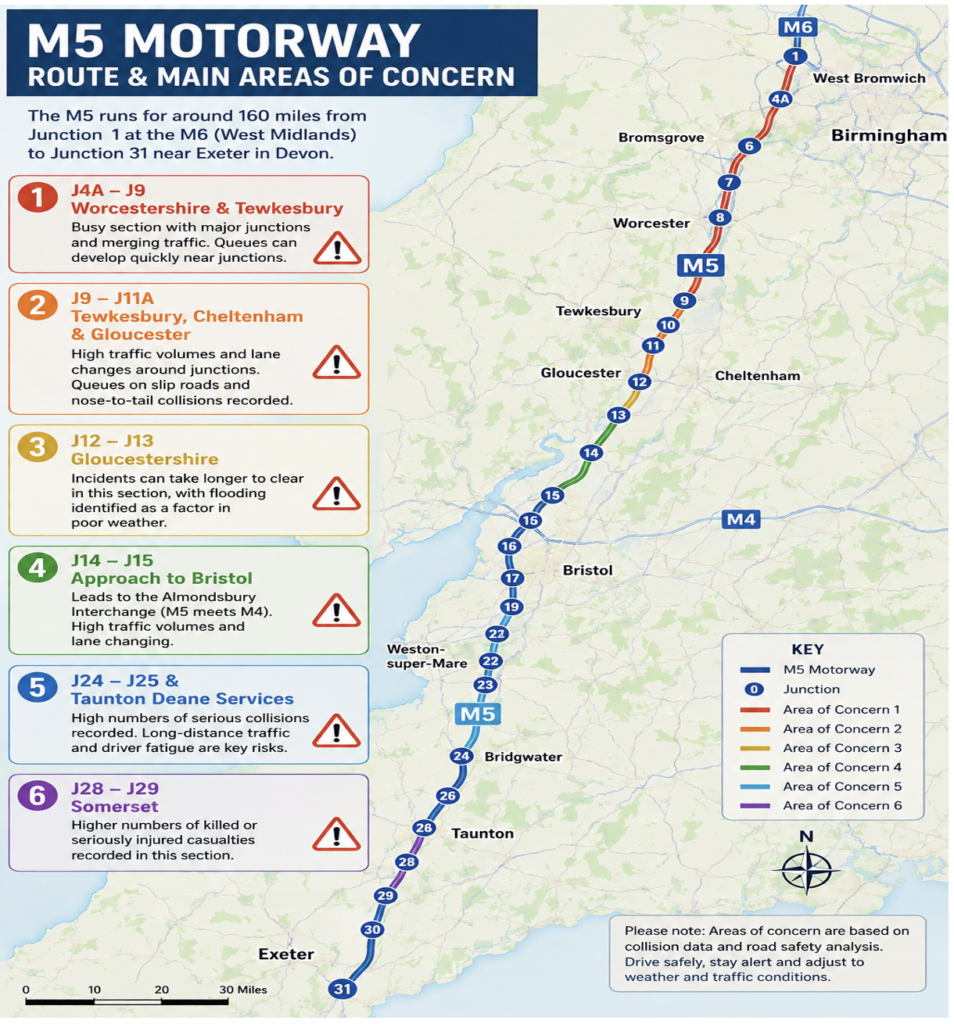
Motorways remain statistically the safest type of road in Britain per mile travelled. They carry around 21% of traffic but account for only 6% of road fatalities. That does not mean the M5 is without risk. High speeds, congestion, sudden braking, lane changing, poor weather and driver fatigue can turn a routine motorway journey into a serious incident very quickly.
Where are the main areas of concern?
National Highways’ analysis of the Birmingham-to-Exeter corridor found that the M5 generally has a low collision rate relative to the amount of traffic it carries. However, it also identified several sections where collisions had resulted in comparatively higher numbers of people being killed or seriously injured.
Where should drivers take extra care?
J4A–J9 – Worcestershire to Tewkesbury
This busy section contains several major junctions and large volumes of merging traffic. Queues can develop quickly, particularly around junction approaches.
Main risks: sudden congestion, merging vehicles and following too closely.
J9–J11A – Tewkesbury, Cheltenham & Gloucester
National Highways has previously identified sections around this area as having higher numbers of people killed or seriously injured. Drivers should be particularly cautious around slip roads and junctions, where traffic can slow unexpectedly.
Main risks: queuing traffic, lane changing and rear-end collisions.
J12–J13 – Gloucestershire
Poor weather can make this section more challenging. Flooding has previously been identified as a factor affecting incidents and their clearance.
Main risks: heavy rain, standing water, spray and reduced visibility.
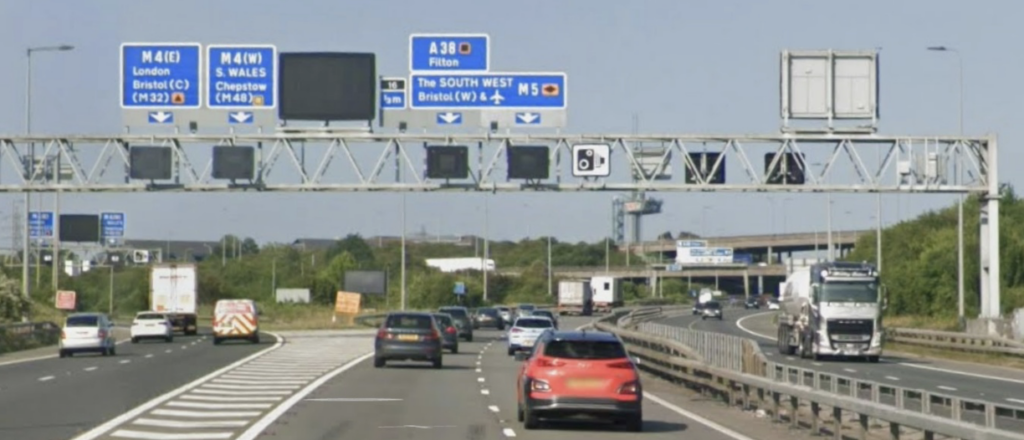
J14–J15 – Approach to Bristol
Traffic becomes increasingly busy approaching the Almondsbury Interchange, where the M5 meets the M4. Drivers unfamiliar with the area can make sudden lane changes when approaching the interchange.
Main risks: heavy traffic, merging vehicles and last-minute lane changes.
J24–J25 & Taunton Deane
Further south, the motorway carries large amounts of long-distance and holiday traffic. National Highways’ historical analysis has highlighted parts of this section for serious collisions. Driver tiredness can also become an issue after several hours behind the wheel.
Main risks: congestion, serious collisions and fatigue.
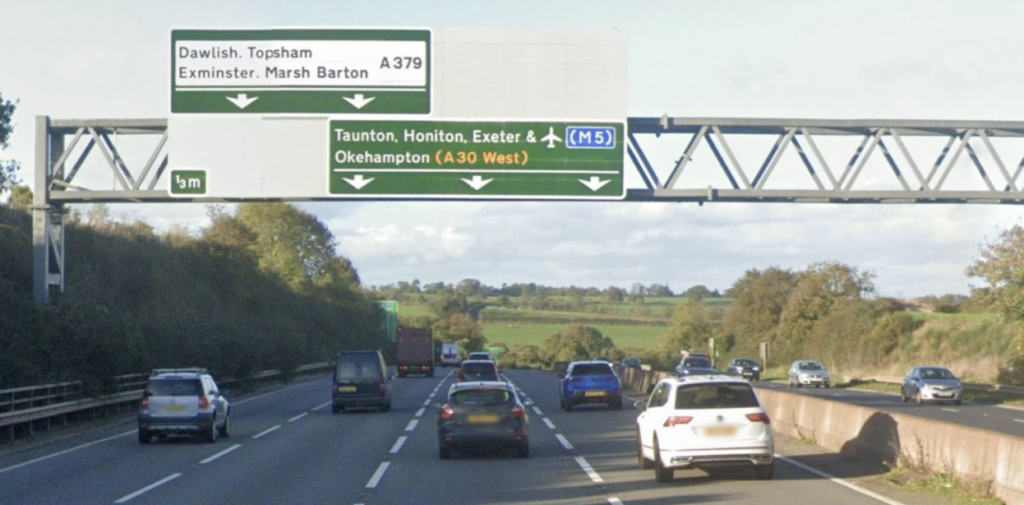
J28–J29 – Somerset/Devon
The approach towards Exeter is another section highlighted in historical collision analysis. For southbound holiday traffic, drivers may already have travelled hundreds of miles before reaching this point.
Main risks: fatigue, changing traffic speeds and loss of concentration.
The biggest risks on the M5
Across the entire motorway, many of the dangers are not unique to one particular junction. Sudden congestion is one of the most important. National Highways has specifically highlighted slip-road queues extending back towards the main carriageway as a safety concern on the Birmingham-to-Exeter corridor. Following too closely dramatically reduces the time available to react when traffic slows. Last-minute lane changes around junctions can put vehicles directly into one another’s path. Heavy rain and spray can reduce visibility within seconds, particularly when passing HGVs.
Driver fatigue becomes increasingly important on long journeys towards the South West, and holiday traffic brings together drivers making long journeys, heavily loaded cars, caravans, motorhomes and motorists who may be unfamiliar with the route.
A motorway that demands concentration
The M5 should not be portrayed as an inherently dangerous road. National Highways’ assessment found that the route generally performs well when collision numbers are considered against the enormous amount of traffic it carries.
But the consequences of a mistake at motorway speed can be severe.
The sections around J4A–J10, Gloucester and Cheltenham, the approach to Bristol, J24–J25, Taunton Deane and J28–J29 deserve particular awareness based on National Highways’ historical collision analysis.
For drivers, the most effective precautions remain straightforward: keep a safe following distance, watch far ahead for queues, choose lanes early, reduce speed in poor weather and take regular breaks on long journeys.
The M5 may be the road that takes millions of people towards their holidays, homes and workplaces each year. Reaching the destination safely matters far more than saving a few minutes along the way.