
The M60 is Manchester’s orbital motorway, forming a roughly 36-mile ring around Greater Manchester and connecting major routes including the M62, M61, M66, M67, M56 and M602.
Used by commuters, HGVs and long-distance traffic, the M60 can become extremely busy. Congestion, complex interchanges, frequent lane changes and sudden queues mean some sections require particular attention.
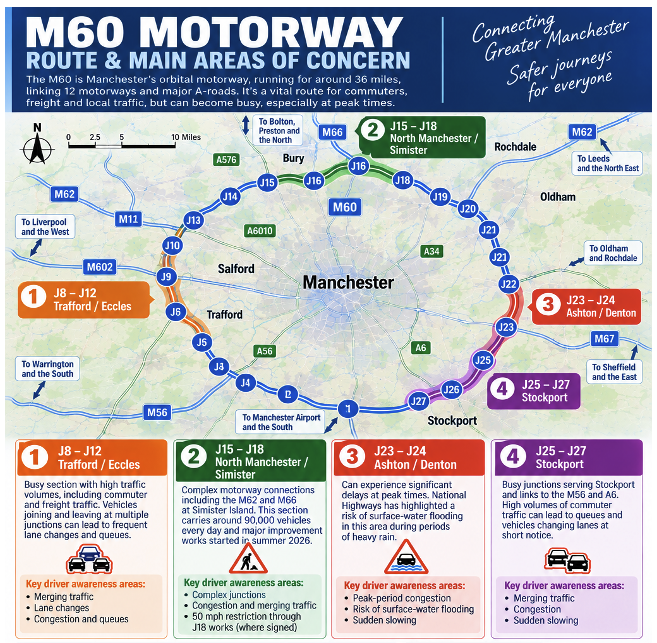
J8–J12 – Trafford & Eccles
The western M60 serves Trafford Park, the Trafford Centre, Salford and Eccles and carries a considerable mixture of commuter and commercial traffic. National Highways has identified the wider J8–J18 corridor as experiencing poor journey reliability and delays, while also noting its importance for Trafford Park, Salford Quays and the movement of goods.
With several busy junctions relatively close together, motorists should expect vehicles frequently joining, leaving and changing lanes.
Main risks: congestion, merging traffic, lane changes and sudden queues.
J15–J18 – North Manchester & Simister Island
The northern M60 contains several important motorway connections, culminating at J18 Simister Island, where the M60 interacts with the M62 and M66. National Highways says Simister Island is one of the busiest motorway junctions in the North West, used by around 90,000 vehicles each day.
Major improvement works began in summer 2026 and are expected to continue until 2029/30. A 50mph restriction is currently in place through the works, with closures and changing traffic arrangements at various stages.
Main risks: roadworks, congestion, complex junctions, merging vehicles and changing lane layouts.
J23–J24 – Ashton & Denton
On the eastern side of Manchester, the M60 serves Ashton-under-Lyne and Denton and connects with the M67.
National Highways has identified the section between J24 and J23 as experiencing peak-period delays, particularly around J24. It has also highlighted a risk of surface-water flooding in this section. During heavy rain, motorists should reduce their speed and increase the distance to the vehicle ahead.
Main risks: congestion, surface water, reduced visibility and sudden slowing.
J25–J27 – Stockport
The southern M60 around Stockport is another section where drivers encounter frequent joining and leaving traffic. Junctions provide access to Stockport and surrounding communities, while nearby connections link the motorway with the A6 and M56 corridor.
Traffic can change speed rapidly around busy junctions, particularly during commuting periods.
Main risks: merging traffic, congestion, lane changes and sudden braking.
Staying Safe on the M60
The M60 can change from free-flowing traffic to heavy congestion very quickly. Drivers should keep a safe following distance, watch well ahead for queues and choose the correct lane early, rather than making last-minute changes approaching junctions. Always obey variable speed limits and Red X signs. Around Simister Island, follow temporary signs and speed restrictions carefully while the improvement works continue.
In heavy rain, slow down and leave considerably more stopping distance, particularly around areas susceptible to surface water.
Key areas to remember
J8–J12: Trafford, Eccles and heavy commuter traffic
J15–J18: north Manchester and Simister Island
J23–J24: Ashton and Denton – congestion and surface water
J25–J27: Stockport and busy junction traffic
The M60 is essential to keeping Greater Manchester moving, but its combination of heavy traffic and closely spaced junctions means conditions can change rapidly. Keeping your distance, planning lane changes early and watching well ahead can help make every journey safer.