
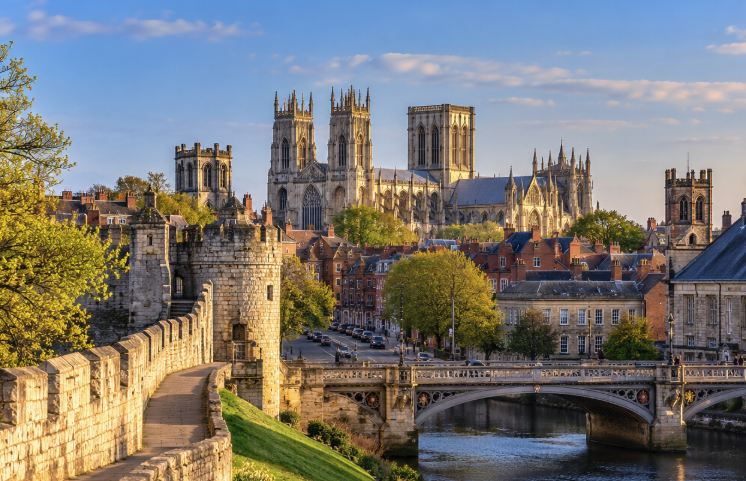
Location Overview – York is a cathedral city of Roman origin, located at the confluence of the Ouse and Foss rivers in North Yorkshire. The city has long-standing buildings and structures, including a minster, castle, and city walls.
York is an excellent location for driver training, offering a varied mix of busy urban roads, challenging junctions, roundabouts, dual carriageways and surrounding rural routes. This diverse driving environment gives drivers the ideal opportunity to develop their observation, anticipation, and hazard awareness skills. From navigating York’s historic city centre and busy ring roads to driving on the A64, A19, and surrounding North Yorkshire country roads, our driver training helps drivers build confidence, improve road safety, and develop smoother, safer, and more efficient driving techniques.
During our driving courses, we cover a range of elements bespoke to the needs of the driver. Below are the common things we look at:
* Looking at a drivers own specific day to day driving, and driving history to make a bespoke training plan
* Looking ahead and developing powers of observation
* Modifying attitude towards a safer, more proactive way to drive
* Increasing focus on speed and excessive speed
* Manoeuvres, reversing, driving in confined spaces
* Becoming a safer urban driver – identifying and dealing with pedestrians and cyclists
* Driving safety on the motorway and dual carriageways
* Learn how to drive in a more environmentally friendly way
* Learning the System of Car Control
* How to avoid road rage situations
* How to boost driving confidence
* Identifying high-risk driving – such as at night, driving tired or when stressed
You will be issued a driving report after each session – sent by email. We fully document this report and attach a unique verification number, proof you’ve trained with a qualified professional. Your report will show how you improved and in what areas, along with useful tips to help you maintain your improved standard of driving.
Key learning points of our driver training:
* Become a safer, more skilful driver
* Address any issues which could be impacting you as a driver
* Demonstrate your intention to become a safer, improved driver
* Finally, deal with and address issues which may have been holding you back
For commercial clients, training is a little different; the end client, the person receiving the training, is often not the person who decides to do it.
While we help the driver to improve, from a commercial perspective, your business will benefit from:
* Demonstrating your businesses Duty of Care
* Potentially lower your fleet insurance costs
* Providing the opportunity for an employee to develop
* Showing you care
* Lower fuel costs
Like most Roman-founded cities, York is well served by straight trunk roads. The city lies at the intersection of the A19 from Doncaster to Tyneside, the A59 from Liverpool to York, the A64 from Leeds to Scarborough, and the A1079 from York to Hull. The A64 provides the principal link to the motorway network, connecting York to the A1 and M1 motorways about 10 miles from the city. The trans-Pennine M62 motorway is less than 20 miles away, providing links to Manchester and Liverpool.
Over the past few years, we have delivered Advanced Driver training in York and the surrounding areas for many reasons: individual drivers with confidence issues, post-RTA courses, motorway training, and corporate fleets across York, including Dunnington, Bishopthorpe, Rawcliffe and Rufford. We will always come to you and use your own vehicle, car, van, campervan, or motorhome for the training.

Our courses do vary in structure, although we have a number of courses based on duration:
3.5hr session
7-hour session (which can be split for 2 drivers if needed)
2 x 3.5hr sessions
We also have longer courses if needed.
Longer Duration Courses:
Our bespoke 3, 4, and 5 x 3.5hr sessions suit those who identify specific driving issues, such as driving anxiety, significant issues on specific roads, or not having driven for a very long time. Private individuals mostly book these longer courses, although they are open to our business clients too.
These longer-duration courses are great for those facing certain (often very specific) issues, as it can take time to build up your skill and confidence levels. The time between sessions is also valuable, as it gives you time to reflect, absorb, and practise what you’ve covered.
Talk with us:
While we try to cover as many things as possible on this page, we understand you may still have questions. If you wish to discuss something, please call or email us. A member of our team will be happy to help. We can help both private individuals and business clients.
If you’re looking for a quote for a large number of drivers, we can provide one, along with a recommended training approach based on your business needs. Training large numbers requires extra planning, but we have years of experience managing large, often complex driver training sessions with multiple start locations and hectic diaries.
Road Safety Risks and Information – York
York is an ancient walled city in the northeast of the UK, served by the A64 and the A59. York attracts thousands of visitors each year, and as a result, numerous accidents have occurred involving drivers unfamiliar with the area.
The A64 meets the A1237 at the Manor Heath roundabouts. Many collisions occur at this intersection, some severe and, sadly, some fatal, so when using intersections like this, be fully aware and in the correct position for your lane exit; this will drastically reduce the chances of a collision. Be mindful of other drivers who may be struggling with their exits so you can avoid them or hold back to give them space. The Askham junction, further along the A64, links to the A1036 (Tadcaster Road), and this route continues into the City Centre via Blossom Street and Micklegate. This route travels through a residential area where pedestrians, cyclists and public transport share the roads.
Collisions are noted at almost every road junction and traffic light system; some have been very severe. The traffic lights at St Helens Road are a hazardous area with many accidents found, and the traffic lights at Dunnery Way and Queen Street have similar statistics; you must be fully aware of your directions and the drivers around you when driving in busy urban areas, especially during rush hours when the majority of these collisions occur. As Micklegate continues across the River Ouse at Bridge Street, collision rates soar, with the Skeldergate junction especially hazardous.
As York is an ancient historical city many of the roads near the centre are very narrow, which now carry much more traffic than they were initially designed to take and this is why many accidents occur, some are minor, scrapes and side windows being caught in tight areas, but they can still cause congestion in such confined areas. It is also vital to take extra care with cyclists using the narrow routes. The A1036 Queen Street merges into Station Road and crosses the bridge to Museum Street; this is also another hazardous route with accidents involving pedestrians and cyclists. This route continues to join the ring road of Lords Mayor Walk and the Foss Islands Road. At the junction of Hull Road and the A1079, take extra care, as this junction has seen far too many severe accidents over the past few years.
If you travel specific roads in York and the surrounding areas and want to know which parts are at higher risk of collisions, please contact us. We understand the importance of your safety, so we offer this service free of charge to anyone who is interested. This service is designed to support you and provide you with the information you need to stay safe on the roads.