
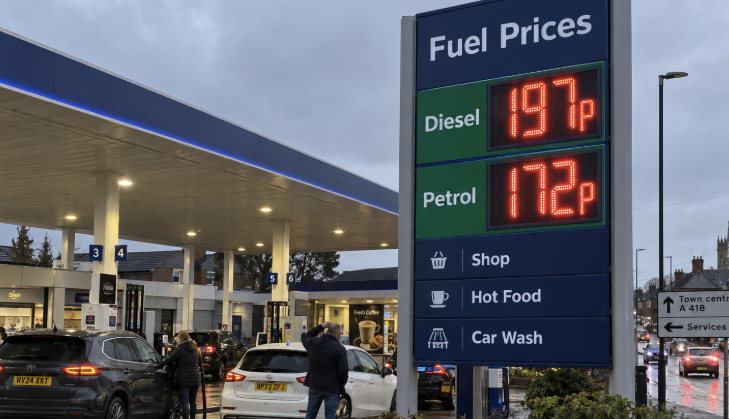
There is something particularly depressing about spending more than £100 at a fuel station. You leave with the same vehicle, the same journeys ahead and the distinct feeling that your money used to take you further.
For diesel drivers especially, the numbers explain why. In its latest update, published on 23 September, the RAC reported an average UK diesel price of 197.31p a litre. At that price, putting 55 litres into your tank costs precisely £108.52.
While you can’t change forecourt prices and you certainly can’t travel back to a time when fuel was cheaper, you can improve your driving enough that diesel (and petrol, for that matter) delivers journeys at prices much closer to what they were before this eternal barrage of price increases.
Here is what the cost of travel means at 197.31p a litre (diesel):
| Average fuel economy | Diesel cost per 100 miles | Equivalent pump price at your original 50 mpg |
|---|---|---|
| 50 mpg | £17.94 | 197.31p per litre |
| 55 mpg | £16.31 | 179.37p per litre |
| 60 mpg | £14.95 | 164.43p per litre |
So if you can increase your average MPG from 50 to 60mpg at today’s prices, it would cost you the same as what you would have paid back in July (July 13th avg diesel prices were 164.52p per litre).
These are examples, not promised results. A 20% improvement is substantial, and a driver who already drives efficiently may have much less scope to improve. Nevertheless, even the 50-to-55 mpg example would save approximately £326 over 20,000 miles, assuming the same diesel price throughout.
So where does advanced driving come into it?
Picture your usual journey. You leave a roundabout and accelerate. Further ahead, traffic is gathering at the next set of lights. You continue building speed, then brake as you approach the queue. Nothing about this necessarily feels aggressive. It may feel completely ordinary.
Now replay the scene…..
This time, you notice the queue while you are still accelerating. You check your mirrors, reassess the approach and ease off earlier, remaining in gear and braking as necessary.
You might still have to stop. But you have avoided spending fuel on speed you were about to lose. That is the principle behind anticipatory driving: identifying what is developing early enough to avoid unnecessary acceleration and braking. It is central to eco-safe driving we teach during our on-road courses.
The useful question you need to ask yourself is not simply whether you are accelerating gently. But what are you accelerating towards? A stationary queue? A red light? A junction where your view will require a cautious approach? Gentle acceleration can still be unnecessary acceleration. Sometimes the most economical use of the accelerator is recognising you don’t need more.
The saving comes from the acceleration you avoid, not from refusing to brake when you need to.
The driver in front should not control your fuel bill
Imagine following someone whose speed keeps changing. They accelerate, so you accelerate. They brake, so you brake. Before long, your right foot is copying their decisions. An appropriate following distance gives you more room to make your own.
We recommend leaving a greater distance so you can sometimes manage changes in traffic speed without braking. That space gives you time to anticipate and react. The Highway Code advises at least a two-second gap on high-speed roads, at least double in the wet, and much more in icy conditions. You must also leave enough room to stop safely if the vehicle ahead suddenly slows or stops.
When another vehicle moves into that space, rebuild the gap smoothly when safe. Treating it as an insult to be corrected with the accelerator does nothing useful for your journey.
Advanced driving happens before the pedals move
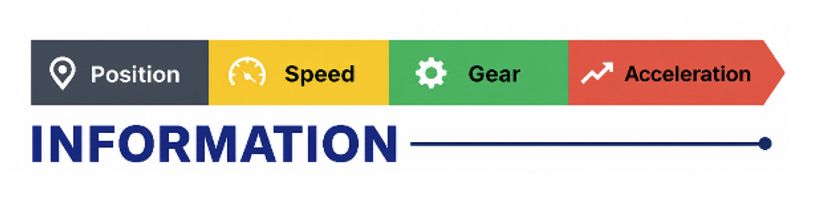
Forward planning and observation are critical elements to consider. The system of car control is a safe, systematic way of driving and approaching hazards. This system was designed by the British Police and is now used all over the world to make drivers safer. The system of car control works through phases: information, position, speed, gear and acceleration. It encourages an organised approach to hazards rather than a last-minute collection of reactions.
Think about approaching a bend. The task is not to carry as much speed as possible into it. It is to gather information, adopt a safe position, establish an appropriate speed and choose a suitable gear before asking the vehicle to accelerate again.
For a manual vehicle, economical gear choice does not mean getting into the highest gear at the earliest possible moment regardless of circumstances. We recommend upshifting early when the vehicle can comfortably accept the next gear, with the right point depending on the vehicle, its load, and the gradient.
A heavily loaded van climbing a hill needs a different decision from an unladen car travelling along a level road. The aim isn’t to keep the engine at the lowest speed. It is to choose the gear that lets the vehicle respond properly without unnecessary revving or struggling.
The system of car control:
Do not confuse effortless cruising with free cruising
On a longer journey, it is worth questioning whether you need to drive at the maximum permitted speed whenever conditions allow. Higher speeds increase fuel consumption. Reducing your cruising speed where appropriate can therefore help, while your speed must always remain suitable for the road and traffic conditions.
Equally, do not turn economy into a different kind of competitive driving. Coasting in neutral or with the clutch held down is not an advanced technique; the Highway Code warns that it can reduce control. An mpg target should never take priority over safe following distances or necessary braking. The object is to remove waste, not judgement.
Give your usual journey a better driver
For your next few journeys, make anticipation the project. Before adding speed, consider what is developing ahead. Notice whether your following distance gives you options. Once safely parked, think back to any occasion when you accelerated and almost immediately needed to slow down.
Was that unavoidable, or was the information available earlier?
Also, how is your speed? Are you checking your speed as much as you should? This is especially true on longer journeys where speed can creep up. At 70mph you’re unaware of the constant wind resistance your car is fighting. A roof rack or excessive weight in the car will also make your car use more fuel. As do underinflated tyres. Consider all these. Also, if your car is due a service, get it done.
For your own comparison, record mileage and litres purchased over several tanks before and after working on your technique. Compare similar journeys and note changes in traffic, weather and load rather than treating one favourable trip as proof.
Our advanced and defensive driving courses cover the skills behind this approach: observation, forward planning, speed awareness, effective use of gears and controls, and eco-safe driving. Training is tailored to the driver rather than delivered as a one-size-fits-all checklist.
You cannot choose what appears on the forecourt sign. But you can work on what happens between one visit and the next. One essential tip you can use to lower fuel costs is practising commentary driving – it helps you look much further ahead and plan.
To make your fuel costs look more like the past, start looking further ahead.