
The final chapter of Britain’s new diesel car market may arrive before many drivers expect. We estimate that UK registrations of new conventional diesel and diesel mild-hybrid cars could fall from approximately 79,000 in 2027 to 34,000 or less in 2029. That would mean annual sales would fall by around 57% between 2027 and 2029, during the final three years of the 2020s.
Under the government’s current phase-out policy, mainstream new-car registrations in that category would then fall dramatically off a cliff to effectively zero from 2030. However, qualifying full hybrids and plug-in hybrids fall into a different category, and the policy exempts certain small manufacturers.
UK new diesel car sales: our 2027–2030 forecast
The table below combines an established industry forecast for 2027 with our own scenarios for the following years.
For consistency, “diesel” follows the Society of Motor Manufacturers and Traders’ headline classification: conventional diesel cars plus diesel mild hybrids. We report full hybrids and plug-in hybrids separately, including those that use a diesel engine. This forecast excludes vans, lorries, and used-car transactions.
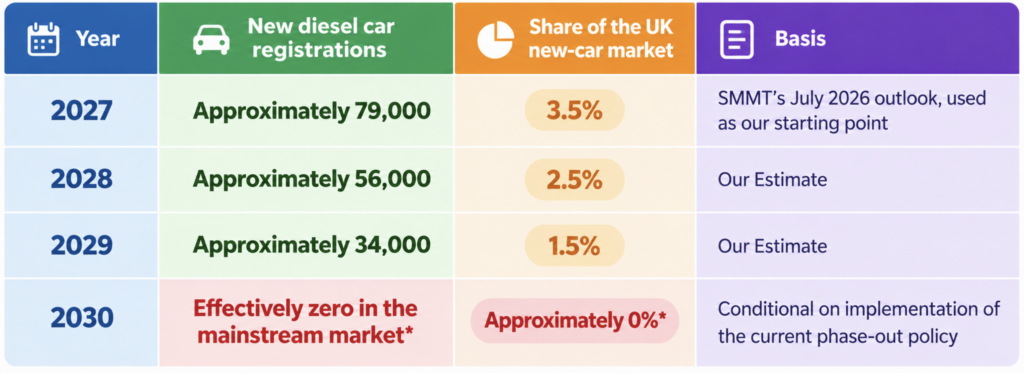
The 2027 figures come from SMMT. The 2028 and 2029 estimates assume a total UK new-car market of 2.25 million registrations annually, with volumes rounded to the nearest thousand. The 2030 endpoint is for conventional diesels and diesel mild hybrids. The methodology and alternative scenarios are explained below.
The main forecast would leave diesel accounting for only one or two of every 100 new cars registered in 2029. That is the key change to consider: not merely fewer diesels, but a market where choosing one becomes an increasingly niche decision.
Where does the UK diesel market stand today?
Diesel’s retreat is already well established. In 2016, diesel cars accounted for 47.7% of UK new-car registrations, close to half the market.
By 2025, the category represented approximately 104,000 registrations and 5.1% of the market. SMMT’s July 2026 outlook projected a further decline to around 94,000 registrations and 4.3% in 2026. Those full-year 2026 figures remain forecasts, rather than completed-year results.
The latest available registration figures provide a useful reality check. Between January and September 2026, the UK registered 77,683 new diesel cars, down 7.1% on the corresponding period in 2025. Diesel’s market share fell from 5.30% to 4.47%. Yet the decline is not uniform. Diesel registrations actually rose 11.5% in September 2026 alone, even while the year-to-date total remained lower. A strong month does not necessarily signal a recovery, just as a weak month does not prove that every remaining buyer has abandoned diesel.
That unevenness is important when predicting the next three years. Model launches, fleet deliveries, discounts and purchasing deadlines could all interrupt the downward trend.
2027: Diesel becomes a more niche purchase
Starting-point forecast: approximately 79,000 registrations, or 3.5% of the market.
For 2027, we use SMMT’s published outlook rather than inventing an alternative starting figure. The more interesting question is what a market of that size might look like. We expect the remaining demand to become more concentrated among buyers with specific requirements: frequent long-distance journeys, particular towing needs, or an established preference for a vehicle whose diesel version still suits their use.
The restriction may be choice, not willingness to buy
Manufacturers do not have to wait for a legal deadline to stop producing a particular engine. For example, Volvo announced in March 2024 that it had built its last diesel car. That illustrates a mechanism we expect to become increasingly important: a driver may remain satisfied with diesel, but the replacement model they want may be available only with another powertrain.
The likely effect is a mixture of outcomes. Some buyers will switch to petrol, hybrid or electric. Others will choose a different manufacturer, purchase a used diesel or keep their existing car longer.
Only some of those decisions support the new diesel market.
Our prediction for 2027 is therefore less about diesel suddenly becoming unsuitable and more about it becoming harder to choose by default.
2028: a smaller market could bring fewer reasons to keep diesel versions
Our estimate: approximately 56,000 registrations, or 2.5% of the market.
Our estimate assumes diesel loses another percentage point of new-car market share in 2028. The commercial logic is straightforward. If demand for a particular diesel version becomes small enough, a manufacturer has less incentive to retain it through a model update, promote it heavily or offer it across multiple specifications.
We expect this to create a reinforcing effect: falling demand could reduce choice, while reduced choice could push more buyers towards other powertrains. This assumes how the market may develop, not that manufacturers have collectively announced those decisions.
Fleet replacement decisions could matter disproportionately
Fleet registrations accounted for approximately 57.5% of the UK new-car market in the first nine months of 2026. Decisions made by businesses and vehicle operators therefore count alongside the preferences of individual motorists.
Consider a business taking delivery of a car in 2028 and expecting to dispose of it three or four years later. Its decision involves more than today’s purchase price and fuel economy. It must also consider suitability throughout ownership and the likely second-hand market when it sells the vehicle.
We expect uncertainty about those future conditions to encourage some businesses to switch earlier rather than later.
Nevertheless, a business with demanding routes, limited charging opportunities or specialist operational needs might reach a different conclusion. Our forecast does not assume every fleet can make the same transition at the same speed.
2029: could a last-minute buying rush interrupt the decline?
Our estimate: approximately 34,000 registrations, or 1.5% of the market.
The final year of the decade could be the least predictable. Our estimate puts diesel at around 34,000 new registrations. That is approximately 45,000 fewer than the 2027 starting point, a reduction of about 57%.
However, an approaching deadline can bring purchases forward. A driver planning to replace a diesel in 2030 might decide to do so in 2029 instead. That creates the possibility of a late rush.
A final buying opportunity is useful only if suitable cars remain available
A substantial surge would require willing customers, suitable vehicles and sufficient supply to coincide. If manufacturers have already withdrawn diesel versions or closed order books, extra demand may translate into stronger interest in existing stock or used vehicles rather than a large increase in new registrations.
There is also an important distinction between placing an order and registering a car. Readers should not assume that ordering before a deadline necessarily guarantees that a vehicle can be registered afterwards; the final implementation rules and delivery arrangements will matter.
Our estimate therefore allows for uneven trading and possible short-lived increases without assuming a broad recovery.
Would the last new diesels become bargains?
Some might. Others might not. A dealer with unwanted stock could discount heavily. A desirable model with limited availability could attract sufficient demand to avoid substantial reductions.
We would be cautious about either extreme prediction: that the final diesels will all be heavily discounted, or that scarcity will make them unusually valuable. The more useful expectation is a fragmented market, with outcomes depending on the model, specification, price and remaining customer base.
2030: what happens to new diesel car sales?
The government continues to say new cars relying solely on internal combustion engines will be phased out by 2030, with all new cars and vans required to be zero-emission by 2035. Its August 2026 announcement reaffirmed those milestones while opening a review of the route towards them.
For this forecast, one key detail is how mild hybrids are treated.
The 2026 consultation explicitly states that conventional petrol and diesel cars and mild hybrids will not meet the intended post-2030 definition. Technical implementation remains under consultation. Therefore, a mild-hybrid should not be treated as an automatic route around the phase-out. Qualifying full hybrids and plug-in hybrids are different. Government policy permits those categories during the transition to 2035. Where a qualifying hybrid uses diesel, it should not be confused with the conventional-diesel and mild-hybrid category forecast in this article.
This is why our 2030 forecast is effectively zero mainstream registrations in the defined diesel category, rather than an absolute prediction that no newly registered car will contain a diesel engine. It is a policy-conditional endpoint. A material change to the phase-out policy would require a new forecast.
How we calculated the forecast
A useful prediction should explain its assumptions rather than present a precise-looking number without a method. This is an illustrative market scenario, not an econometric model or a new survey of manufacturers.
We begin with SMMT’s July 2026 forecast of approximately 79,000 diesel registrations in a total 2027 market of 2.245 million cars. For 2028 and 2029, we hold the overall market broadly steady at 2.25 million registrations annually.
We then assume diesel’s share falls by one percentage point annually, from 3.5% in 2027 to 2.5% in 2028 and 1.5% in 2029.
The calculation is:
Total new-car registrations × assumed diesel market share = projected diesel registrations
For example:
2,250,000 × 1.5% = 33,750, rounded to approximately 34,000 registrations in 2029.
The one-percentage-point decline is an editorial modelling assumption reflecting our expectation of tighter supply, stronger competition and the approaching phase-out. It is not a post-2027 SMMT forecast.
Although the assumed market-share loss is the same in each year, its proportional effect becomes larger as diesel’s remaining market becomes smaller. That is why the rounded registration figures fall by approximately 29% in 2028 and 39% in 2029.
What happens under different assumptions?
To show how sensitive the result is, the table below gives three illustrative outcomes for 2029.
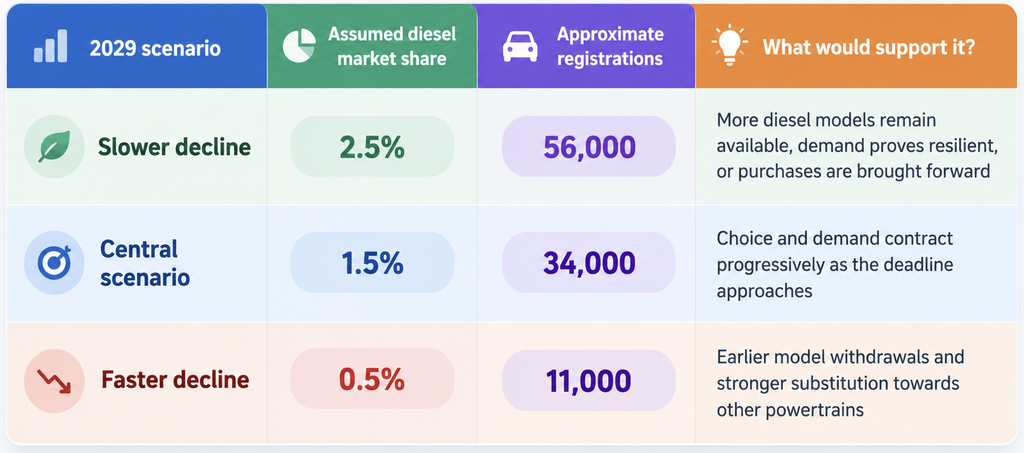
These are alternative assumptions, not statistical confidence intervals.
The overall size of the car market is important too. At a diesel share of 1.5%, a two-million-car market would produce 30,000 diesel registrations, while a 2.5-million-car market would produce 37,500.
The precise number is uncertain. The central proposition is that diesel could become a very small part of new-car buying before the formal phase-out takes effect.
Will diesel cars disappear from UK roads in 2030?
No. The new-car market and the cars already on the road are two different things.
SMMT’s vehicle-in-use figures for the end of 2025 recorded approximately 11 million diesel cars, representing 30.1% of the UK car population. That existing population is vastly larger than a single year’s new diesel registrations.
The planned new-car phase-out is not a requirement to scrap an existing diesel. It also does not, by itself, prevent people from buying and selling used diesels. This distinction explains why diesel can become almost absent from new-car showrooms while remaining familiar on motorways, rural roads and driveways.
Local emissions rules are a separate consideration. For example, London’s current Ultra Low Emission Zone standard for diesel cars is Euro 6; it is not a blanket prohibition on every diesel car. Drivers should check the rules for the places they actually visit rather than treating the national sales phase-out as a substitute for local requirements.
Will shrinking new sales make used diesels worthless?
Our new-car forecast cannot predict the resale value of an individual vehicle. Two competing effects could, however, influence that value.
Reduced appetite for diesel could weaken prices. At the same time, fewer new diesels entering the market could eventually reduce the supply of younger used examples sought by buyers who still prefer them.
Neither effect guarantees a particular outcome.
A well-maintained diesel that meets a buyer’s needs might remain attractive. Another model, offered at the wrong price or with an unsuitable history, might be much harder to sell.
The sensible conclusion is not whether diesels will hold their value or if diesels will become worthless. It is that resale assumptions need closer scrutiny when buying a new diesel near the end of the decade.
Should you buy a new diesel in 2027 or 2028?
A shrinking market does not automatically make every remaining diesel a bad purchase. Equally, previous satisfaction with diesel does not prove it is the best choice for the next ownership period.
Start with the journeys the car will actually make.
A driver covering frequent long distances should compare suitable diesel, hybrid and electric models using realistic costs and practical requirements. Someone mainly making short urban trips should be particularly careful about choosing a diesel simply because the advertised fuel economy looks attractive.
It is also worth distinguishing between needing a diesel and needing a particular capability. Long-distance comfort, towing ability, carrying capacity and dependable journey planning should be assessed model by model, rather than assumed from the fuel type alone.
The bigger change: diesel may leave the shortlist before it leaves the road
Our central forecast is that new diesel registrations could more than halve between 2027 and 2029, before the current phase-out policy takes mainstream conventional diesels and diesel mild hybrids out of the new-car market in 2030.
For motorists, the practical response is to separate market forecasts from personal requirements. Understand the rules, question resale assumptions and choose a vehicle for the journeys ahead, not simply the one that most closely resembles the car being replaced.
Diesel Diehards
For diesel diehards, the main motivation behind their decision to stick with diesel may be one of the heart. They love and trust diesels, have used them for decades, and will want to keep with them for as long as possible. Probably for as long as they can still drive, in some cases.
People who make this decision and buy a new diesel vehicle right up to the 2029 deadline, will become among the very last owners of vehicles powered by a trusted fuel, which powered much of the nation’s transport for decades. For some, sticking with what they know is what brings them joy, and who is to criticise them for that?